A dentist in Vancouver called me after six months of paying an SEO agency that had delivered what she described as strong organic growth. Her website traffic had increased by 40 percent. Her blog posts were ranking for informational keywords about dental health. Her domain rating had climbed from 12 to 24.
But her appointment book was not full. New patient enquiries from Google had not meaningfully increased. When I asked where her practice was appearing in Google Maps, she had no answer. When I searched her primary keywords in Vancouver, her website appeared on page two of organic results and nowhere in the local 3-pack.
Her agency had been running an organic SEO strategy for a business that needed local SEO. The tactics they used were not wrong in isolation. They just did not address the search formats that drive bookings for a local dental practice. Traffic to a dental blog post about teeth whitening does not convert into appointments at the same rate as a position one Google Maps listing for dentist near me.
If you want expert help with this, explore our Local SEO Services — we work with service businesses across the UK, Dubai, and UAE.
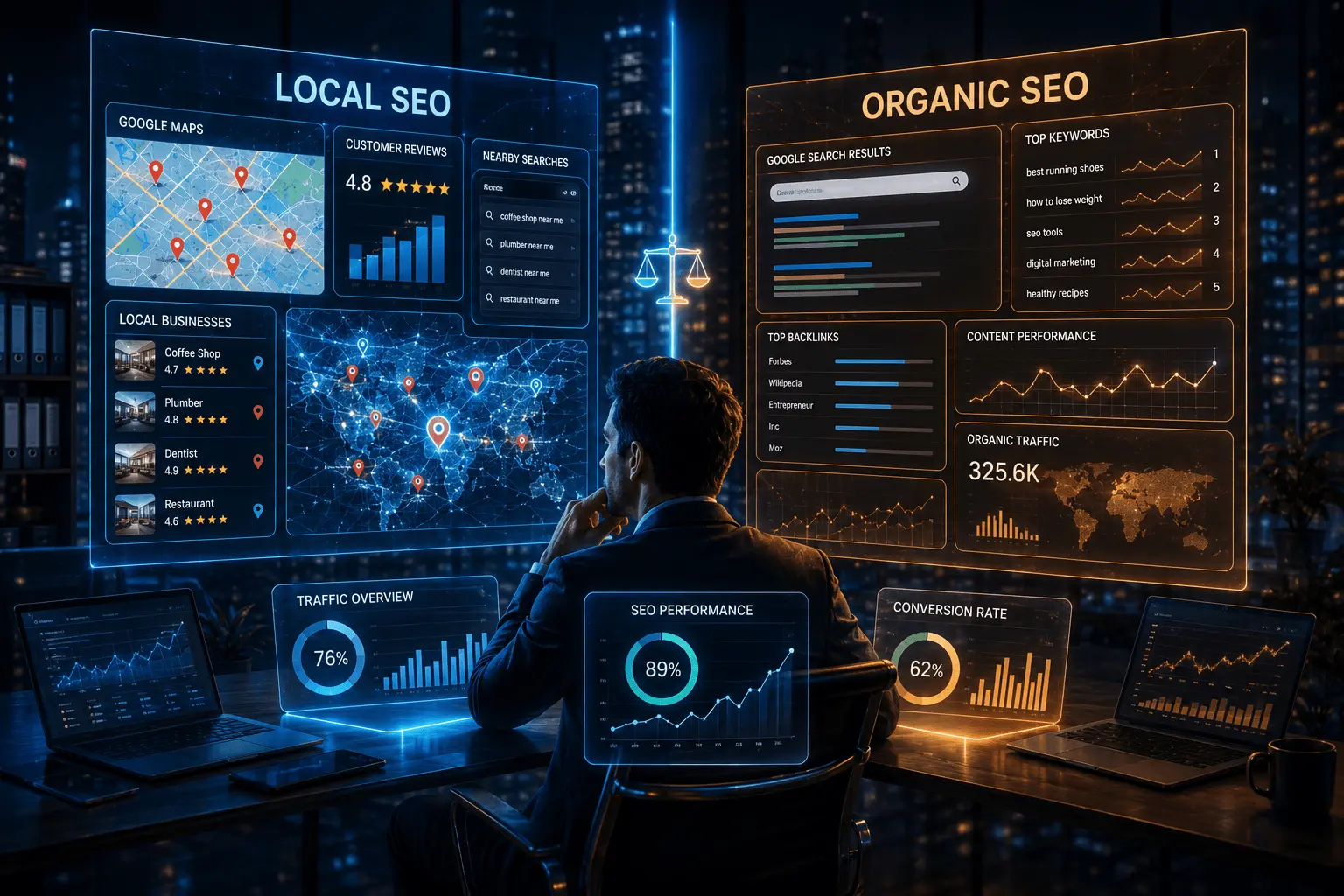
This is one of the most expensive misunderstandings in digital marketing for small and medium businesses. Local SEO and organic SEO are related disciplines that share some tactics but serve different purposes, target different search formats, and require different optimisation strategies. Understanding the distinction is not academic. It determines whether your SEO investment produces revenue or just metrics.
What Is Organic SEO and What Does It Actually Target?
Organic SEO is the practice of improving a website's visibility in Google's standard search results, the blue links that appear below any ads and below the local pack. These results are ranked primarily by the quality and authority of the website content, the strength of the backlink profile pointing to that content, and how well the content matches the intent behind the search query.
Organic search results appear for every type of search. Informational queries like how to whiten teeth at home, commercial queries like best electric toothbrush, and transactional queries like book dental appointment online all produce organic results. The businesses that rank in organic results can be local, national, or global. Location of the searcher is less of a determining factor in organic rankings than in local rankings.
Organic SEO tactics include keyword research and content creation targeting specific search queries, technical SEO improvements to website speed and structure, and building backlinks from relevant external websites. The goal is to build domain authority that earns ranking positions across a wide range of keyword targets over time.
The timeline for organic SEO is typically measured in months. New content on a website with modest authority rarely ranks on the first page immediately. Authority builds gradually through consistent content production and backlink acquisition. The organic results for competitive keywords are dominated by established websites that have been building signals for years.
What Is Local SEO and How Is It Fundamentally Different?
Local SEO is the practice of improving a business's visibility specifically in local search results. These include the Google Maps 3-pack that appears at the top of search results for location-specific queries, Google Maps search results directly, and the localised organic results that appear below the 3-pack for searches with clear local intent.
Local search results are triggered when Google detects that the searcher is looking for a business or service in a specific geographic area. This can happen explicitly, when someone types dentist in Vancouver, or implicitly, when someone types dentist near me and Google uses their location to determine relevance.
The businesses that appear in local search results are evaluated by Google using a different set of signals than those used for organic rankings. Your Google Business Profile is the centrepiece of local search visibility. Citation consistency across directories, review volume and recency, and proximity to the searcher all directly influence local pack rankings in ways they do not influence standard organic rankings.
A business with a strong GBP, 150 consistent reviews, and clean citation data can rank in the local 3-pack even if its website has relatively modest domain authority. Conversely, a business with a powerful website and strong domain authority can rank well in organic results while being completely absent from the local 3-pack if its GBP is neglected or its citation data is inconsistent.
These two ranking systems operate in parallel but they are not the same system and they do not respond to the same optimisation inputs in the same way.
The Key Signal Differences That Separate the Two
Google Business Profile: Local SEO Only
Your GBP is the single most influential factor in local pack rankings and it has almost no direct effect on standard organic rankings. Investing in GBP optimisation, review collection, and GBP posting activity produces local search results. It does not directly improve your website's position in the organic blue link results below the local pack.
Backlinks: More Important for Organic
Backlinks from external websites are the dominant signal in organic SEO. They are also a factor in local SEO but carry less relative weight compared to GBP signals and citation data in local pack rankings. A local business can rank in the top three of Google Maps with a modest backlink profile if its other local signals are strong. Ranking on the first page of organic results for competitive non-branded keywords typically requires a substantially stronger backlink profile.
Content: Critical for Organic, Supporting for Local
Content quality and volume drive organic rankings directly. A website with comprehensive, well-structured content targeting specific keywords earns organic ranking positions through the relevance and authority that content represents. For local SEO, on-page content contributes to local relevance signals but a blog with 50 posts does not guarantee local pack visibility the way a fully optimised GBP does. Location pages, service pages with local keyword signals, and schema markup are the content elements most directly relevant to local rankings.
Citations and NAP Consistency: Local SEO Only
Citation consistency across directories is a local SEO factor with no equivalent in standard organic SEO. The consistency of your business name, address, and phone number across Yelp, Bing Places, Apple Maps, and industry directories signals local legitimacy to Google. This signal type simply does not exist in the organic ranking framework, which focuses on content authority and backlinks rather than business data verification.
Which Type of Search Intent Each One Captures
The practical difference between local and organic SEO becomes clearest when you look at the type of searches each one captures and the conversion behaviour associated with those searches.
Local searches have high purchase intent. Someone searching dentist near me, emergency plumber, or hair salon open Sunday is typically ready to take action within hours. Google's own research has found that 76 percent of people who search for something nearby on their smartphone visit a business within a day. Local search is bottom-of-funnel traffic with urgent need and immediate availability as primary decision factors.
Organic searches span the full funnel. How to fix a leaky tap is top-of-funnel research. Best plumber tools is mid-funnel comparison. Emergency plumber contact number is bottom-of-funnel. Informational organic traffic is valuable for building brand awareness and trust but converts into appointments or purchases at lower rates than local search traffic because the searcher is often in research mode rather than decision mode.
For a local service business, local search traffic converts at significantly higher rates than informational organic traffic. A dental practice that ranks in the local 3-pack for dentist Vancouver captures searchers ready to book. A dental practice that ranks organically for how to care for dental implants captures readers interested in the topic who may or may not become patients.
Both audiences have value. The local search audience drives immediate revenue. The organic audience builds long-term trust and brand recognition that supports future conversions. Treating them as interchangeable is the mistake the Vancouver dentist's agency made.
Why Local Businesses Need Both Strategies Running in Parallel
The businesses with the strongest and most defensible online presence in competitive local markets are running both local SEO and organic SEO simultaneously. They are not choosing one or the other. They are using each to serve a different purpose within the same overall growth strategy.
Local SEO captures high-intent nearby searchers and drives immediate enquiries and bookings. This is the engine of short to medium-term revenue from search. A business that dominates the local 3-pack for its primary service keywords in its city is capturing the most commercially valuable search traffic available to a local business.
Organic SEO builds domain authority that supports local SEO over time, captures research-phase traffic that builds brand familiarity before someone is ready to buy, and ranks for service keywords in non-local formats that the 3-pack does not cover. A well-ranking service page for a specific high-value treatment or service can capture searchers who are comparing options rather than searching for a nearby provider and may reach out specifically based on the content they read.
The interaction between the two strategies is real and compounding. A website with strong domain authority from organic SEO sends better on-site signals that support local pack rankings. A business with strong local SEO and a fully optimised GBP earns more branded searches that strengthen its organic domain authority. Running both in parallel produces a reinforcing cycle that neither strategy produces in isolation.
How to Decide Where to Start
If you are a local service business with a physical location or defined service area and you are choosing where to invest your SEO budget first, local SEO almost always produces faster and more direct revenue impact. The local 3-pack drives more immediate appointment enquiries and calls than organic blog content. Fix your GBP, clean your citations, build your review profile, and align your website's local signals before investing heavily in content marketing and link building for organic rankings.
Once your local search presence is solid and producing consistent inbound enquiries, expand into organic SEO to build longer-term authority and capture research-phase searches that your local pack listings do not address. This sequencing matches the timeline of returns: local SEO produces results within weeks to months, organic SEO compounds over months to years.
The Vancouver dentist rebuilt her strategy with this sequencing in mind. We paused the blog content production, optimised her GBP comprehensively, cleaned her citation profile, launched a review collection system, and built local service pages with schema markup on her website. Within 90 days she was ranking in the local 3-pack for dentist Vancouver and three suburb-level keywords. New patient enquiries from Google increased by 160 percent in the first quarter after the changes. The blog content her agency had produced remained on the site as a trust-building asset, contributing to branded searches and session duration rather than driving direct bookings.
Frequently Asked Questions About Local SEO vs Organic SEO
Yes, and the strongest local businesses often do. Appearing in both the local 3-pack and the organic results below it for the same keyword effectively doubles your visibility on that search results page. This dual presence is achieved by optimising your GBP and local signals for the pack while building website authority and service page content for organic rankings. The two systems are complementary and can both be won for the same keyword target.
Not directly. Your GBP is a separate entity from your website in Google's ranking systems. Improving your GBP signals improves your local pack position but does not directly pass authority to your website's organic rankings. The indirect benefit is that strong local pack visibility generates more branded searches for your business name, which contributes to organic brand authority over time. The two systems are related but GBP optimisation is not a substitute for website SEO.
Local SEO produces faster results in almost every case. GBP optimisation, citation cleanup, and review collection can produce measurable local pack ranking movement within four to twelve weeks. Organic SEO improvements to website content and backlinks typically take six to twelve months to produce first-page rankings for competitive keywords. For a local business needing near-term revenue improvement from search, local SEO is the faster path by a significant margin.
A blog is not required for local pack rankings. Many local businesses rank in the top three of Google Maps with websites that have no blog content at all. A blog becomes valuable for capturing organic traffic from informational and research-phase searches, building domain authority through content that earns backlinks, and supporting branded searches that strengthen overall domain signals. It is a medium to long-term investment in organic visibility rather than a local pack ranking requirement.
The local pack, sometimes called the 3-pack or Map Pack, is the block of three local business listings that appears at the top of Google search results for queries with local intent. Each listing shows the business name, rating, address, and a link to the GBP. Below the local pack, standard organic results appear as traditional blue links to web pages. The local pack is driven by GBP signals and local authority. The organic results are driven by website content and backlinks. Both appear on the same page but are produced by different ranking systems.
You can rank in the local pack with only a Google Business Profile and no website, particularly in low-competition markets. However, having a website strengthens your local rankings through on-page signals, schema markup, and NAP alignment between your site and GBP. Without a website, you are also invisible in organic results and cannot capture traffic from informational or research-phase searches. For most local businesses, a basic well-optimised website significantly outperforms a GBP-only presence even if the website is simple.
Growing organic traffic from informational content does not automatically produce more calls or bookings. Visitors reading blog posts about industry topics are typically in research mode, not purchase mode. If your calls are not growing alongside your traffic, the traffic increase is coming from top-of-funnel informational keywords rather than high-intent local searches. The fix is investing in local SEO to rank in the 3-pack for transactional local keywords rather than expecting informational blog traffic to convert at the same rate as local search traffic.
Yes. Service area businesses that operate from a home base or van and serve customers at their location can still create and optimise a Google Business Profile. You define your service area by the cities or postcodes you cover rather than listing a physical address. Service area businesses can rank in the local pack for their target areas, though they face a slight proximity disadvantage compared to businesses with a physical presence in the search area. Strong GBP optimisation and review velocity largely compensate for the lack of a fixed location.
For most local service businesses, prioritise local SEO first until your 3-pack presence is established and producing consistent inbound enquiries. Local SEO delivers faster and more direct revenue returns for service businesses. Once local SEO is producing reliable results, expand budget into organic content and link building to compound authority over the longer term. The exact split depends on your market competition, revenue stage, and whether your customer acquisition happens primarily through local search or through researching phase decision making.
Not directly. The local pack and organic results are separate ranking systems that do not directly influence each other's outputs. However, ranking in the local pack increases your branded search volume as more people discover and search for your business name directly. Higher branded search volume is associated with stronger domain authority signals in organic rankings over time. The relationship is indirect and long-term rather than immediate and causal.
Two Systems, One Goal: More Customers From Google
The Vancouver dentist's agency was not incompetent. They ran a legitimate organic SEO strategy and produced real results by the metrics they were tracking. The problem was a mismatch between the strategy they delivered and the search behaviour of someone ready to book a dental appointment. People searching for a dentist in Vancouver are not reading blog posts about oral hygiene. They are checking Google Maps listings, reading reviews, and clicking the call button.
Local SEO captures those people. Organic SEO captures the ones who are earlier in the decision process. Both have a role in a complete local business growth strategy. The businesses that treat them as the same thing end up optimising for one while neglecting the other and wondering why half their potential Google audience is finding a competitor instead.
Understand which search behaviour drives your direct revenue. Build local SEO first. Add organic SEO as a compounding layer on top. Run them in parallel as the business matures and the budget allows. That sequencing produces the most direct path from zero Google visibility to a search presence that fills your appointment book, service schedule, or order queue consistently.
Which type of SEO do you think is most neglected in your industry right now and why? Share your perspective in the comments below.
Want Results Like This for Your Business?
Get a free Local SEO audit — we will show you exactly what is holding your rankings back and the fastest path to the Google map pack.
Talk to a Local SEO Specialist →