A plumber in Portland called me after spending $4,800 on a website redesign that delivered zero measurable improvement in leads. His new site looked great. It loaded fast. A developer had added service pages, optimized title tags, and set up Google Analytics. Six months after launch, he was getting the same 12 to 15 calls per month he had always gotten, all from existing customers and word of mouth. Google was sending him almost nothing.
When I looked at his setup, the website was genuinely solid. Not perfect, but competently built. The problem was what he had ignored while obsessing over the website. His Google Business Profile was set up three years ago and never touched since. His primary category was listed as "Contractor" instead of "Plumber." His business description was two sentences long. He had 11 reviews, the most recent from 14 months ago. His GBP had no photos beyond the auto-generated map thumbnail. He was not showing up in the local map pack for a single plumbing keyword in Portland.
He spent $4,800 on his website and zero hours on his GBP. We flipped that ratio for 90 days. We corrected his category, completed his description, uploaded 30 photos, built a review generation system, and started posting weekly GBP updates. His website did not change by a single line of code. Within 11 weeks he ranked in the top three map pack results for seven plumbing keywords in his service area. Monthly calls from Google jumped from near zero to 34.
If you want expert help with this, explore our Google Business Profile Optimisation — we work with service businesses across the UK, Dubai, and UAE.
That experience crystallized something I now explain to every local business client at the start of our relationship: Google Business Profile and website SEO are not competing priorities. They operate in different parts of the local search ecosystem and influence different types of rankings. But if you are a local business with limited time and budget, understanding which one to invest in first, and why, changes everything about the results you get. This guide gives you the clearest answer I can offer based on real campaign data.
How Local Search Actually Works: Two Separate Ranking Systems
The single biggest source of confusion about GBP versus website SEO is that most local business owners do not realize Google runs two distinct ranking systems for local queries. Understanding both systems is the foundation of making smart decisions about where to invest your time.
When someone searches "plumber near me" or "emergency plumber Portland," Google typically displays two types of results on the same page. The local map pack appears near the top of the results and shows three local businesses with their ratings, hours, phone numbers, and a map. Below the map pack, organic blue-link results appear just like they do for any other search. These two result types are powered by different ranking systems and optimized through different activities.
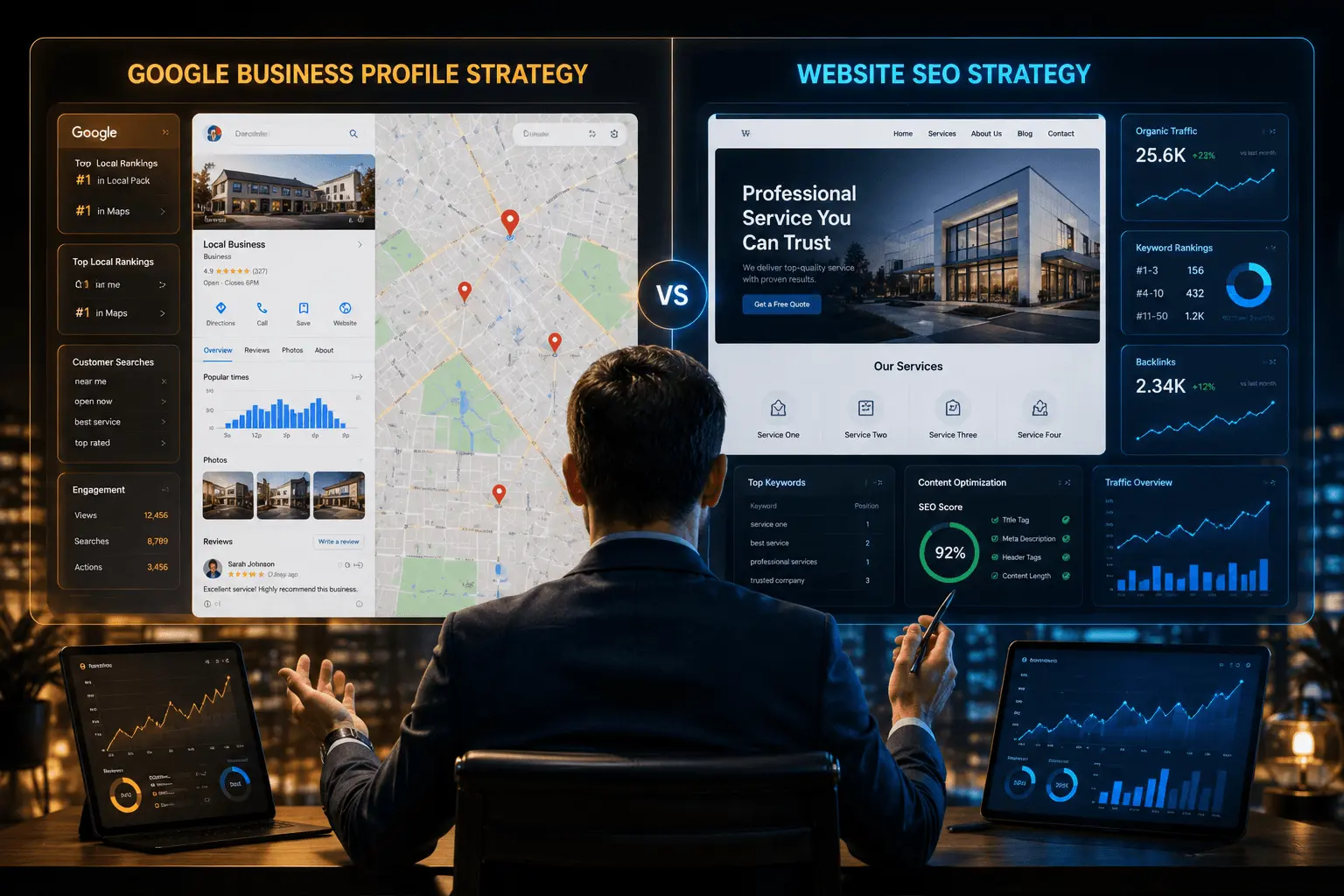
Your Google Business Profile is what determines whether and where you appear in the local map pack. Your website SEO determines whether and where you appear in the organic results below the map pack. A business can rank strongly in the map pack with a mediocre website. A business can rank strongly in organic results while being invisible in the map pack. The most competitive businesses rank in both simultaneously, but building both takes time, and most local businesses should prioritize one before the other based on their current situation.
The map pack almost always generates more clicks than organic results for local service queries. Studies from BrightLocal and Moz consistently show that the local map pack captures 44 to 60% of clicks on local search results pages, while organic results below the map pack capture 15 to 30%. If you are a local service business and you are not in the map pack, you are invisible to the majority of people searching for what you do, regardless of how well your website ranks organically.
What Google Business Profile Controls and Why It Dominates Local Intent Searches
Your Google Business Profile is the direct input to the local map pack ranking algorithm. Google uses three primary factors to determine map pack rankings: relevance, distance, and prominence. Your GBP is the primary vehicle through which you communicate all three signals to Google.
Relevance is determined largely by your GBP category selection, your business description, your services list, and the keywords that appear naturally throughout your profile content. A plumber who selects the primary category of "Plumber" and lists services like "drain cleaning," "pipe repair," and "water heater installation" tells Google exactly what searches to surface them for. A plumber whose GBP category is "Contractor" with a vague description tells Google almost nothing useful.
Distance is the one factor you cannot control through optimization. Google uses the searcher's location and your verified business address to calculate proximity. What you can influence is your service area settings, which tell Google the geographic radius you serve and allow you to appear in searches from outside your immediate address location. Setting an accurate, appropriately sized service area in your GBP settings is one of the most underutilized map pack optimizations available.
Prominence is where GBP optimization, reviews, and your website work together. Google assesses how well-known and trusted your business is online through the volume and quality of your reviews, the completeness and activity level of your GBP, the consistency of your citations across the web, and the authority of your website. A GBP with 180 recent reviews, weekly posts, and 60 photos on a domain with solid website authority will consistently outrank a GBP with 20 old reviews and an abandoned profile, even when both businesses are at similar distances from the searcher.
The GBP Signals That Most Directly Influence Map Pack Rankings
- Primary and secondary category selection: the single highest-impact GBP decision you make
- Review volume and recency: 180 reviews from the past 12 months consistently outranks 400 reviews averaging two years old
- Review responses: responding to every review within 48 hours signals active business management
- Photo volume and recency: businesses with more than 100 photos receive 520% more calls than those with fewer than 10
- Post frequency: weekly GBP posts signal an active, engaged business to Google's local algorithm
- GBP completeness: every unfilled field is a missed signal, description, services, hours, attributes, and Q and A all matter
- Citation consistency: your NAP data must match exactly across every directory where your business appears
What Website SEO Controls and When It Becomes the Priority
Website SEO governs your visibility in the organic results below the map pack and in searches where the map pack does not appear at all. Not every local search triggers a map pack. Informational queries like "how much does a plumber charge to fix a leak" or "what causes low water pressure in a house" produce only organic results. A plumber whose website ranks for those informational queries captures potential customers earlier in their decision process, builds trust before those customers are ready to call, and can close the gap between first awareness and first contact.
Website SEO also matters enormously for competitive map pack rankings over the longer term. One of Google's three map pack ranking factors, prominence, is directly influenced by your website's authority and the quality of content it contains. A GBP linked to a well-optimized, authoritative website will outrank an otherwise identical GBP linked to a thin, poorly optimized website in competitive markets. The website is the foundation that your GBP builds upon. Neglect it entirely and your map pack ceiling is lower than it needs to be.
The Website Elements That Influence Local Rankings Most
Not all website SEO activities carry equal weight for local rankings. The elements that most directly influence local visibility, both in organic results and indirectly in the map pack, are location-specific service pages, on-page NAP consistency, structured data markup, mobile performance, and locally relevant backlinks.
Location-specific service pages are the highest-impact website investment for most local businesses. A dedicated page for each core service in each city or neighborhood you serve, with genuine, locally relevant content rather than copied text with swapped city names, tells Google that you are a serious provider of that service in that specific area. A plumber with separate pages for "drain cleaning in Portland," "pipe repair in Portland," and "water heater installation in Portland" has three ranking opportunities in organic results where a plumber with one generic services page has one. Over time, those pages also contribute to the GBP's prominence signals.
On-page NAP consistency means your business name, address, and phone number appear on your website in exactly the same format as on your GBP and across all your directory listings. Even small discrepancies, like "Suite 4" on your website versus "Ste. 4" on your GBP, create citation inconsistencies that chip away at Google's trust in your location data. Your NAP should appear in the footer of every page on your site and in the body of your contact page in plain text, not as an image.
GBP vs Website SEO: What Each Controls in Local Search
| Factor | Google Business Profile | Website SEO | Both Work Together |
|---|---|---|---|
| Map pack visibility | Primary driver | Indirect via prominence | GBP leads, website supports |
| Organic result rankings | Minimal direct impact | Primary driver | Website leads, GBP supports |
| Review management | Direct, primary channel | Schema markup helps display | GBP is where reviews live |
| Local keyword targeting | Categories and services list | Service and location pages | Both reinforce each other |
| Click-to-call conversions | Phone number prominent in pack | Mobile-friendly site closes the call | GBP starts, site completes |
| Trust and credibility signals | Reviews, photos, posts | Content, E-E-A-T, author bios | Combined trust picture |
| Citation authority | NAP consistency at GBP | NAP in footer and contact page | Must match perfectly |
| Voice search visibility | GBP powers many voice answers | FAQ schema supports voice | Both contribute |
Which Should You Prioritize First? A Decision Framework
The honest answer is that both matter and the strongest local businesses invest in both consistently. But most local businesses do not have unlimited time and budget. When you have to choose where to focus first, the right answer depends on your current situation rather than a universal rule.
Prioritize Your GBP First If Any of These Apply
Your business is not showing up in the map pack at all for your primary service keywords. Your GBP was set up once and has never been actively managed. You have fewer than 30 reviews or your most recent review is more than three months old. You have fewer than 25 photos on your GBP. Your primary category selection does not precisely match your core service. Your GBP business description is under 400 characters or completely generic.
In any of these situations, GBP optimization will produce faster and more dramatic results than website SEO because the map pack drives the majority of clicks on local search pages and because GBP improvements often reflect in rankings within four to eight weeks, compared to three to six months for typical website SEO outcomes. The Portland plumber's situation was a textbook case of GBP neglect in a business that would have benefited far more from 20 hours of GBP work than from a $4,800 website rebuild.
Prioritize Website SEO First If Any of These Apply
Your GBP is already well-optimized and you are ranking in the top three of the map pack for your main keywords but want to grow beyond map pack visibility. Your business operates in a large metro area where map pack competition is extremely high and GBP optimization alone is not enough to break into the top three. You serve multiple cities and need dedicated location pages to appear in searches across your full service area. Your business relies on informational content to attract customers in the research phase before they are ready to call. Your website currently loads in more than four seconds on mobile, which is suppressing both your organic rankings and the website link in your GBP listing.
The Scenario Where Both Need Equal Attention Immediately
If you are launching a new business or a business that has had no digital presence at all, GBP and website SEO need to be built simultaneously from the start. A new business needs its GBP verified and optimized before anything else because the map pack is where most local customers will encounter your business first. But a new GBP linked to a website with no content, no location pages, and no structured data will hit a prominence ceiling quickly. Build both from day one rather than sequencing them.
How GBP and Website SEO Amplify Each Other When Both Are Strong
The most important insight about GBP versus website SEO is that the question itself is slightly wrong. It implies a competition between two alternatives when the reality is a symbiotic relationship where each makes the other more effective. Understanding how they amplify each other helps you allocate effort more strategically across both rather than treating them as separate campaigns.
A strong GBP drives traffic to your website. Every click on the website link in your GBP listing sends a potential customer to your site. If your website converts poorly because it loads slowly, lacks clear calls to action, or does not have the information a customer needs to feel confident calling, you waste the traffic your GBP generates. Your GBP and website need to work as a seamless funnel, not as independent assets.
A strong website increases your map pack rankings. Google's prominence signal for map pack rankings is partly determined by the authority and relevance of your website. A plumber with a DR 35 website and 15 location-specific service pages will outrank a plumber with a DR 8 website and one generic services page in competitive markets, even if their GBP quality is identical. Investing in website authority through backlinks and content over time raises the ceiling on what your GBP can achieve in the map pack.
Your website content creates GBP posting material. A regular cadence of blog posts about local topics, completed projects, seasonal tips, and service guides gives you a constant source of content for your weekly GBP posts. Those posts keep your profile active, which Google rewards with higher prominence scores. The content strategy you run for website SEO and the content you need for GBP management are not separate workstreams. They are the same content repurposed across two channels.
The 90-Day Plan for Businesses Starting From Scratch on Both
If you are reading this with both an underperforming GBP and a website that needs work, the following 90-day sequence consistently produces the fastest visible results without spreading effort so thin that neither channel improves meaningfully.
Days One to Thirty: GBP Foundation
- Verify your GBP if not already verified and correct any outdated information immediately
- Select the most specific primary category for your main service and add three to five relevant secondary categories
- Write a complete 750-character business description leading with your city and primary service in sentence one
- Upload a minimum of 25 photos covering exterior, interior, team, and service or product shots
- Complete your services list with individual entries for every service you offer with descriptions
- Set up a review generation system and begin requesting reviews from your most recent satisfied customers
- Publish your first GBP weekly post and commit to posting every week from this point forward
Days Thirty-One to Sixty: Website Foundation
- Run your site through Google PageSpeed Insights and fix any mobile performance issues scoring below 70
- Ensure your NAP appears in your site footer and contact page in plain text matching your GBP exactly
- Add LocalBusiness schema markup to your homepage with your full NAP, hours, and service area
- Create dedicated service pages for your top three services if they do not already exist
- Add FAQ sections to each service page targeting the questions your customers actually ask
- Audit your citation consistency across Google, Yelp, Apple Maps, and Bing Places and fix any discrepancies
Days Sixty-One to Ninety: Amplification
- Begin a review velocity push targeting a minimum of eight new reviews per month going forward
- Publish one locally relevant blog post or project case study on your website
- Build your first two to three local backlinks through Chamber of Commerce membership, local press outreach, or partner site links
- Check your map pack rankings for your top five keywords and document your baseline position
- Identify the two service and location page combinations with the highest search volume and create dedicated pages for each
Frequently Asked Questions About GBP vs Website SEO
Yes, technically. Google allows GBP listings without an associated website and some businesses do appear in map pack results without one. However, operating without a website significantly limits your map pack ranking potential because your website is one of the inputs to Google's prominence calculation. Without a website, you have no location pages, no structured data, no ability to build backlinks, and no platform for content that supports your GBP's relevance signals. You can get initial visibility in the map pack without a website but you will hit a ceiling quickly in any market with meaningful competition. A basic, well-optimized website is not optional for serious local SEO in 2025.
Not directly. Your GBP ranking and your organic website ranking are produced by two separate algorithms that do not feed directly into each other. However, they share indirect relationships. A well-optimized GBP that generates reviews mentioning your business name and service keywords creates brand signals that can modestly influence how Google evaluates your overall online presence. Conversely, a strong website with high domain authority improves your GBP's prominence score, which is a direct map pack ranking factor. The relationship is real but indirect. Do not expect improving your GBP to automatically improve your organic rankings or vice versa.
Review volume and recency are among the most reliably documented map pack ranking signals. BrightLocal's annual Local Consumer Review Survey consistently shows that businesses with more than 100 reviews significantly outperform businesses with fewer than 25 reviews in map pack visibility, holding other factors equal. The recency dimension matters as much as volume: a business with 50 reviews all from the past six months often outperforms a business with 200 reviews whose most recent review is 18 months old. Google interprets review recency as a signal that the business is currently active and providing consistently good service. Aim for a minimum of eight new reviews per month rather than a one-time push toward a total number.
Yes, indirectly but meaningfully. Google uses your website as a source of information about your business when assessing prominence for map pack rankings. A website with detailed, locally relevant service pages helps Google understand exactly what your business does and where it operates, which improves the relevance dimension of your map pack ranking. A website with backlinks from credible local sources increases your domain authority, which feeds into prominence. A website with consistent NAP data reinforces the location accuracy of your GBP listing. None of these are direct GBP ranking inputs but they collectively influence the third-party signals Google uses to evaluate how prominent and trustworthy your business is in its local market.
A website redesign that maintains your URL structure, keeps your NAP data consistent, preserves your existing content, and does not significantly change your site's technical performance should have minimal impact on your GBP ranking. Redesigns that change your domain, remove location-specific content, slow your page speed significantly, or disrupt your existing backlink structure can temporarily suppress both your organic rankings and indirectly your GBP prominence. Before any significant website redesign, document your current rankings for key local terms and set up 301 redirects for any URLs that are changing. Give Google four to eight weeks after a redesign to fully recrawl and reassess your site before drawing conclusions about ranking impact.
Google offers a basic website builder through the GBP interface that creates a simple single-page website from your GBP information. Do not use it as your primary website. These auto-generated sites have almost no SEO value, cannot be customized with location-specific service pages, cannot host blog content, and do not allow you to build the technical foundation needed for serious local organic rankings. They were a useful stopgap for businesses with absolutely no web presence but they are not a substitute for a real website with genuine content and optimization. If you currently use the GBP auto-generated site, migrating to a proper WordPress or similar platform website should be your first priority.
Search your primary service keyword plus your city name in Google from a location near your business address. If you are not appearing in the map pack at all, or appearing in positions four through ten, your GBP is the primary constraint and where your effort should go first. If you are appearing in the map pack but not in the top three, look at the GBP profiles of the businesses ranking above you and compare review volume, photo count, post recency, and category selection. If your GBP looks comparable to theirs on those metrics, your website prominence is likely the differentiating factor. If you are in the map pack top three but want more overall local search visibility, your website organic rankings are the next growth lever to pursue.
Stop Choosing Between Them. Understand What Each One Does.
The Portland plumber did not need to choose between his GBP and his website. He needed to understand that his website was already doing its job adequately and his GBP was doing almost nothing. Once that diagnosis was clear, the decision about where to invest the next 90 days was obvious. Eleven weeks later he had 34 calls per month from Google instead of near zero.
That is the right way to frame this question for your own business. Not which one matters more in the abstract, but which one is currently the binding constraint on your local search performance. For most local businesses that have been online for more than two years and have invested any effort in their website, the GBP is the underinvested asset. For newer businesses or those in highly competitive metro markets, both need genuine simultaneous investment.
The businesses that dominate local search in 2025 are not the ones who picked the right channel. They are the ones who built both channels to a high standard and maintained them consistently. A genuinely excellent GBP linked to a genuinely useful, technically sound website is a combination that most local competitors never achieve because it requires sustained effort across two different disciplines over a long period of time. That sustained effort is exactly why it produces such durable competitive advantage when you do it.
Where does your local search performance break down right now: is it the map pack, the organic results, or both? Drop your situation in the comments and I will give you a specific diagnosis and a prioritized action plan for your business type and market.
Want Results Like This for Your Business?
Get a free Local SEO audit — we will show you exactly what is holding your rankings back and the fastest path to the Google map pack.
Talk to a Local SEO Specialist →