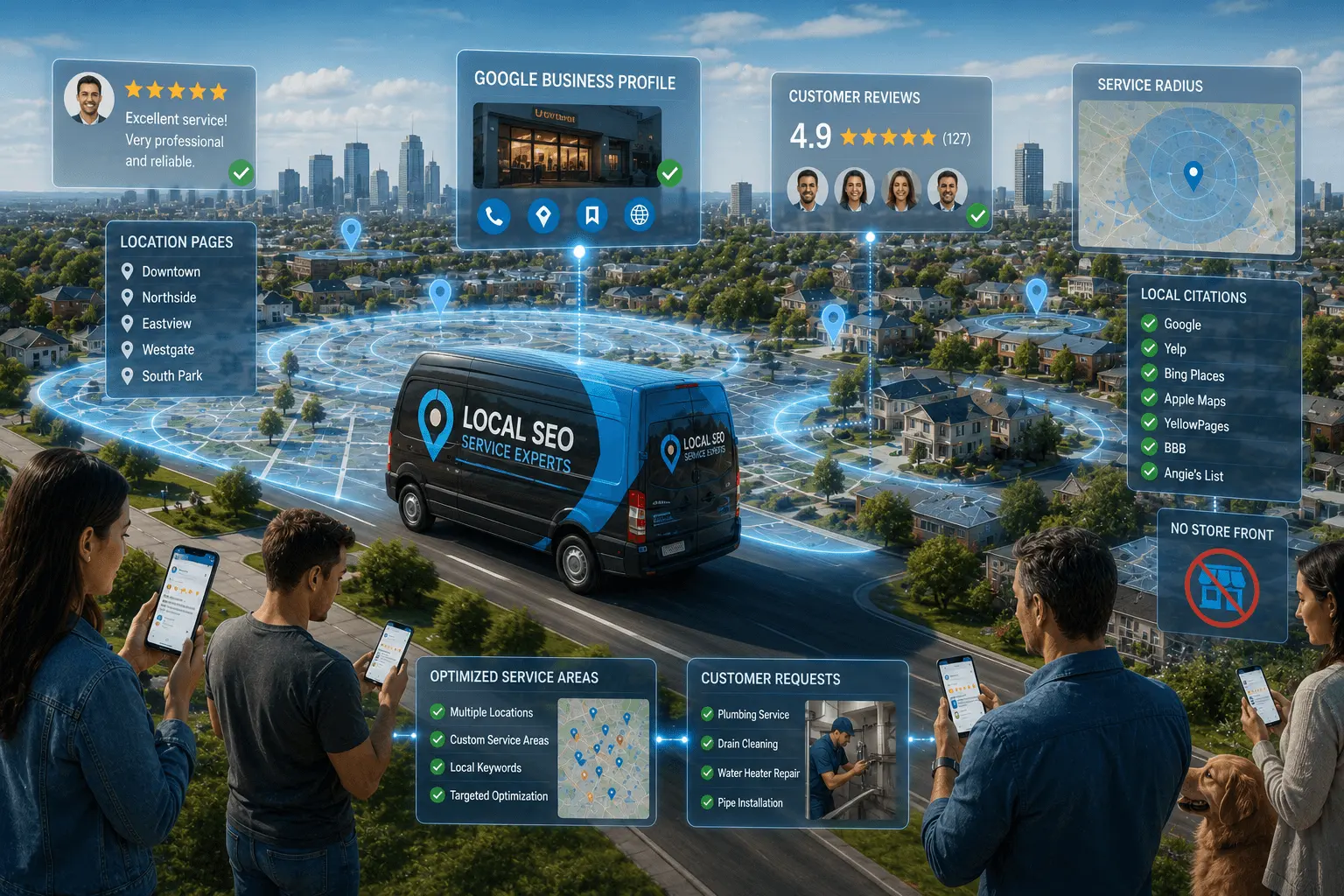
A mobile dog groomer I worked with ran her entire business out of a van, driving to customers across a 30-mile radius with no fixed location anyone could visit. She'd been told by a well-meaning friend that Google Maps was basically off-limits to her since she had no storefront to point to. That advice was wrong, but it's advice I hear constantly, and it stops a lot of legitimate mobile and service area businesses from ever trying to compete in local search at all.
Service area businesses, plumbers, electricians, cleaners, landscapers, mobile mechanics, tutors, pet groomers, and dozens of other trades that travel to the customer rather than the other way around, can absolutely rank in Google Maps and local search. The setup is different from a storefront business, and a few of the rules genuinely do change, but the opportunity is just as real. Here's exactly how it works.
What Counts as a Service Area Business
Google defines a service area business, often shortened to SAB, as one that visits or delivers to customers directly rather than customers visiting a fixed business address. This covers a huge range of industries: home services like plumbing, HVAC, roofing, and pest control, mobile services like dog grooming, car detailing, and personal training, and professional services like tutoring, consulting, or in-home healthcare.
If you want expert help with this, explore our Local SEO Services — we work with service businesses across the UK, Dubai, and UAE.
If customers never walk into your location, or if you rent a small office purely for administrative work with no public-facing storefront, you likely qualify for service area business settings rather than a traditional storefront listing.
Setting Up Your Google Business Profile as a Service Area Business
Hide your address
In your Google Business Profile settings, there's a specific option for businesses that don't serve customers at their address. Selecting this hides your physical address from public view while still allowing you to use it internally for verification. This matters both for accuracy and, frankly, for privacy if you're operating out of a home office.
Define your service area precisely
Google lets you list specific cities, postal codes, or a radius around your base location. Be honest and specific here. Listing an entire state or a radius far beyond where you realistically serve customers doesn't expand your visibility the way it might seem to. It dilutes your relevance for the areas you actually want to rank in, and it can look suspicious to Google's spam detection systems if your review history and business size don't match a service area that large.
Choose the right categories
The same rules that apply to storefront businesses apply here: pick the single most accurate primary category, then add every genuinely relevant secondary category. A mobile pet groomer should select pet grooming as the primary category rather than a broader, less accurate label like pet services.
The Core Ranking Factors Work the Same Way, With One Key Difference
Relevance, distance, and prominence still determine your ranking as a service area business, just as they do for storefront businesses. The key difference is how distance gets calculated. Without a public address, Google estimates your position based on the general area you've configured in your service area settings, along with signals from your website and citations. This makes precise, honest service area configuration more important for SABs than it is for storefront businesses, since it's doing more of the work that a physical address would otherwise handle.
Building Location Pages That Actually Work
If you serve multiple distinct towns, suburbs, or districts, dedicated pages for each area can meaningfully expand your visibility, but only if they're built well. This is the step where a lot of service area businesses undermine themselves.
What not to do
Don't create a template page, swap out the city name, and publish twenty nearly identical pages. Google's algorithms are good at detecting thin, duplicated content, and a stack of templated location pages can do more harm than good, both by diluting your site's overall quality signals and by failing to actually convince a real customer you know their specific area.
What to do instead
- Mention specific neighborhoods, landmarks, or streets within that service area naturally in the content
- Include any genuine local context: common issues customers in that area face, typical property types, or regional considerations relevant to your service
- Add a testimonial or example specific to that area if you have one
- Write unique service descriptions for each page rather than reusing identical paragraphs with only the city name changed
- Keep the page genuinely useful on its own, not just a thin wrapper around your main service page
If you only serve two or three distinct areas, it's often better to build fewer, stronger location pages than to stretch thin content across ten separate ones just to claim broader coverage.
Reviews Matter Even More for Service Area Businesses
Without a physical location for customers to associate with your brand, reviews do a disproportionate share of the trust-building work. A customer can't drive past your storefront and get a feel for your business the way they might for a retail shop. Their entire impression is built from your online profile, your reviews, and your photos.
The same review request principles apply here as anywhere else: ask right after the job is done, make it effortless with a direct link sent by text, and never offer incentives in exchange. For mobile and service area businesses specifically, timing the request for the moment right after the technician or provider leaves tends to convert particularly well, since the service is fresh and, ideally, the customer is relieved and satisfied.
Photos Do More Work When You Don't Have a Storefront
Storefront businesses can lean on exterior shots and interior ambiance photos to build trust. Service area businesses need to work a little harder here, but the raw materials are usually already available.
- Photos of your vehicle, ideally with clear branding, since this is often the first thing a customer visually associates with your business
- Before and after photos of completed jobs, which double as both trust builders and portfolio pieces
- Photos of your team actively working, which humanizes a business that customers might otherwise only interact with by phone
- Equipment or tools photos if relevant, particularly for trades where customers care about professionalism and preparedness
A well-photographed van showing up consistently across your profile does more trust-building work than most service area businesses give it credit for.
Citations and NAP Consistency for Businesses Without a Public Address
NAP consistency still matters just as much for service area businesses, even though the address portion works a little differently. Since your address is hidden from public view, your business name and phone number carry even more weight in cross-referencing your legitimacy across directories. Keep these identical everywhere you're listed, and where a directory requires an address for verification purposes, use it consistently even if it isn't displayed publicly.
Industry-specific directories matter just as much here as they do for storefront businesses. A mobile mechanic benefits from listings on automotive-specific directories the same way a general contractor benefits from construction industry directories, regardless of whether either business has a public storefront.
Common Mistakes Service Area Businesses Make
- Leaving the service area radius set to the default, which is often far too large or too small for the actual business
- Trying to use a home address as a public storefront address to appear more established, which violates Google's guidelines for service area businesses
- Skipping photos entirely because there's no storefront to photograph, when vehicle, team, and work photos are just as effective
- Building thin, templated location pages that add more clutter than value
- Assuming service area businesses can't compete with storefront businesses in the same market, which discourages consistent optimization effort that would otherwise pay off
- Listing multiple business categories that don't accurately reflect the core service, in an attempt to appear for more searches
A Realistic Path to Ranking Without a Storefront
Start with an honest, precise service area configuration and full category accuracy. Layer in consistent reviews, ideally requested right at the moment a job wraps up. Add genuine photos of your vehicle, team, and completed work on a regular basis. Build a small number of genuinely useful location pages rather than a large number of thin ones. Keep your NAP consistent everywhere your business appears, even where the address itself stays hidden. None of this requires a storefront, and businesses that execute this consistently tend to compete just as effectively in local search as their storefront counterparts, sometimes more effectively, since service area businesses are often more responsive to review requests given the direct, in-person nature of most jobs.
Frequently Asked Questions
Yes. You can enter your address for Google's internal verification purposes while selecting the setting that hides it from public view. This keeps your listing verified without exposing your home address publicly.
Set it to reflect where you genuinely and reliably serve customers, not the maximum distance you'd theoretically be willing to drive for the right job. An honest, moderate radius tends to outperform an inflated one over time.
Yes. A website reinforces the same relevance and trust signals it does for any business, and it's where your location pages, service descriptions, and additional content live, all of which support your Google Business Profile rather than replace it.
Generally no, a single listing should cover a single, contiguous service area tied to one base location. If you have genuinely separate operations in distant regions, each typically needs its own properly configured listing rather than one listing stretched across disconnected areas.
Yes, and in many local service categories, service area businesses regularly outrank storefront competitors, particularly when the storefront competitor has neglected their profile while the service area business has stayed consistent with reviews, photos, and accurate information.
Final Thoughts
Not having a storefront isn't a disadvantage in local search the way a lot of business owners assume. It just means a few settings need to be configured correctly and a few areas, reviews and photos especially, need slightly more deliberate attention to make up for the trust signals a physical location would otherwise provide automatically. That mobile groomer I mentioned at the start set her service area honestly, started collecting reviews after every appointment, and began posting simple photos of her van and her work. Within four months she was showing up in the local pack for searches across most of the towns she actually served, right alongside groomers who had a physical shop customers could walk into.
Is your service area radius actually set to reflect where you really work, or is it still on the default?
Want Results Like This for Your Business?
Get a free Local SEO audit — we will show you exactly what is holding your rankings back and the fastest path to the Google map pack.
Talk to a Local SEO Specialist →