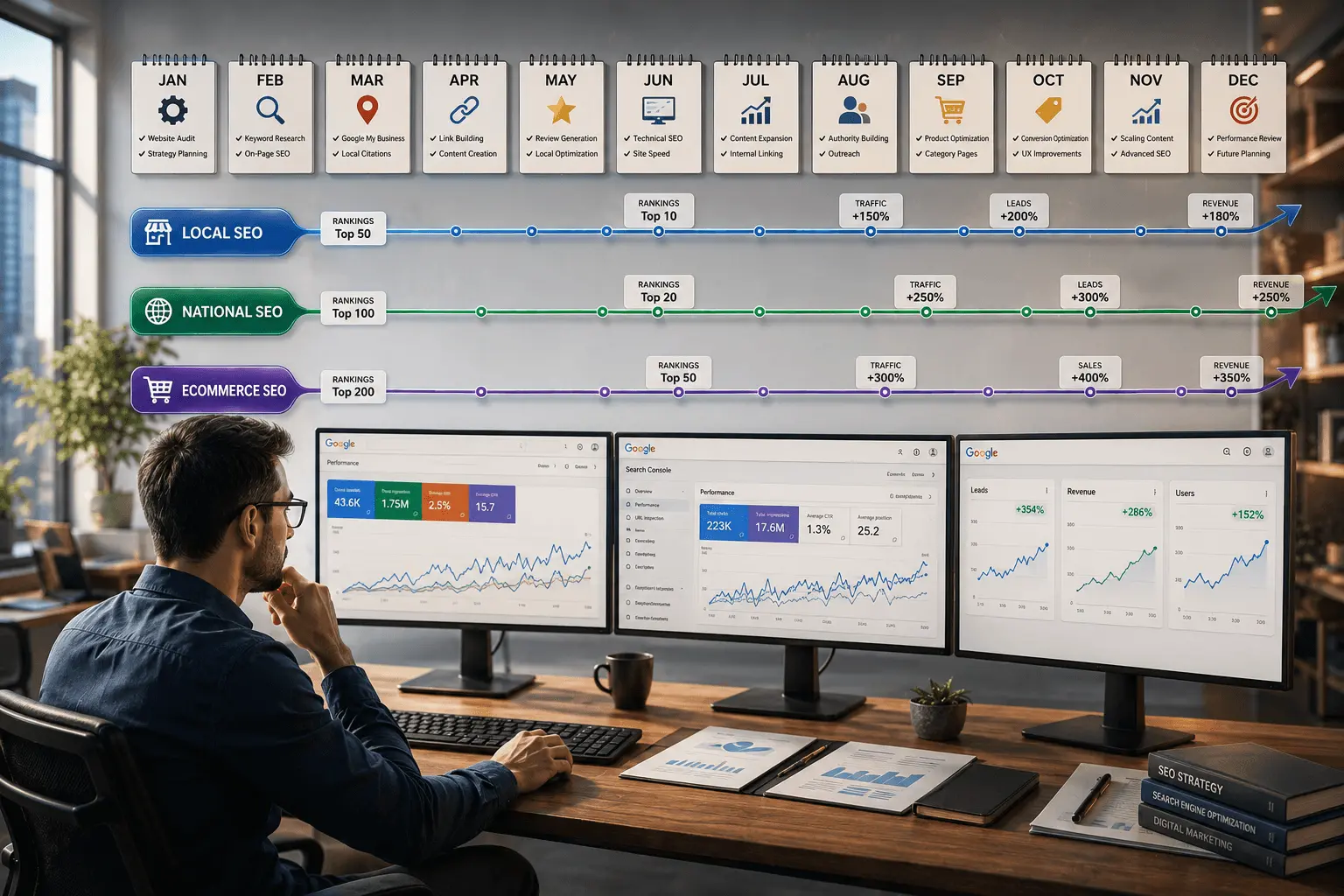
Three months into working with a new client, I received an email that I suspect every SEO professional recognizes immediately. Daniel ran a mid-size plumbing company in Leeds. We had optimized his Google Business Profile completely, fixed 40 citation inconsistencies, built seven local backlinks, launched four new location pages on his website, and implemented a review generation system that had taken him from 18 reviews to 51.
His email read: "I appreciate the work but I have to be honest. I am not seeing results yet. My competitor is still above me. Should I be worried?"
The honest answer required a longer conversation than a quick reply could carry. Because Daniel's question, "when does SEO start working," is both completely reasonable and more complicated than most SEO guides are willing to admit.
If you want expert help with this, explore our Local SEO Services and Map Pack Ranking — we work with service businesses across the UK, Dubai, and UAE.
The answer changes dramatically depending on whether you are doing local SEO, national organic SEO, or e-commerce SEO. It changes based on how competitive your market is, how old your domain is, how much your competitors have already invested, and what condition your website and online presence were in before you started. A local plumber in a mid-size city operates in a completely different SEO environment than a national software company or a direct-to-consumer e-commerce brand selling in a saturated product category.
Daniel's situation resolved well. By month five his listing sat at position two for his most valuable search terms and his inbound call volume had grown by 44%. But getting him there required helping him understand what the timeline actually looked like and why, which is exactly what this guide covers for every major SEO context.
Why SEO Timelines Are Genuinely Different Across Business Types
The frustration most business owners feel about SEO timelines comes from a real problem with how the industry communicates. Generic answers like "SEO takes three to six months" are not wrong exactly, but they flatten meaningful differences across contexts into a single estimate that applies accurately to almost no specific situation.
Local SEO, national SEO, and e-commerce SEO operate under different algorithmic priorities, face different competitive landscapes, and respond to different types of investment. A local HVAC company competing against twelve other local operators for the top three Google Maps positions is not playing the same game as a SaaS company competing for first page rankings against established national publications with decades of domain authority.
Understanding the specific dynamics of your SEO context is the starting point for setting realistic expectations, making smart investment decisions, and avoiding the mistake of abandoning a strategy right before it starts producing results. That last scenario, stopping at month four of a process that was about to break through at month five, is one of the most expensive SEO mistakes a business can make.
How Long Local SEO Takes to Work
Local SEO has the shortest credible timeline of the three contexts covered in this guide. That is both its most compelling advantage and one of the most frequently overpromised aspects of working with local SEO agencies.
For a local service business starting from a relatively clean baseline, meaning a claimed Google Business Profile, a functional website, and a modest review count, meaningful ranking movement in the Google Maps Local Pack typically becomes visible within 60 to 90 days of consistent optimization. That is not a top three position in most cases. It is early movement, position improvement from outside the top ten to a spot where your listing is at least showing up in extended results.
Reaching and holding a top three Local Pack position in a moderately competitive market, a category with eight to fifteen active competing businesses in a mid-size city, typically takes four to six months of sustained effort. That sustained effort includes consistent review generation, regular profile posting, ongoing citation building, website location page development, and steady local backlink acquisition.
In highly competitive markets, personal injury law in a major metro area, HVAC repair in a large city with national franchise competition, or dentistry in a dense suburban market, reaching the top three can take seven to twelve months. The businesses currently occupying those positions in competitive markets did not get there accidentally. They have accumulated months or years of review velocity, citation consistency, and local authority that cannot be closed in a single quarter regardless of how aggressively you optimize.
Daniel's situation was a moderately competitive market. His competitors had a head start measured in months rather than years. That timeline, meaningful movement at month three to four and top two positioning by month five, reflects a realistic pace for a well-executed local SEO campaign in that type of environment.
The most common reason local SEO takes longer than expected is inconsistency. A business that optimizes aggressively for six weeks and then reduces its activity for two months because results were not yet visible will consistently underperform a business that applies steady, moderate effort every single month. Google's local algorithm rewards consistency signals over time. Bursts of activity followed by inactivity produce inconsistent results that frustrate business owners and mislead them about whether the strategy is working.
The Specific Local SEO Milestones to Expect Month by Month
Rather than a single timeline estimate, understanding the typical progression of local SEO results helps business owners calibrate their expectations against their actual experience.
In months one and two, the changes happening are mostly invisible in ranking reports. Google is crawling your updated profile, processing your new citations, and beginning to associate your business with your target keywords and geography. Review count is growing. Citation inconsistencies are being corrected. The work is being done but the ranking needle has not moved meaningfully yet. This is the phase where most businesses with unrealistic expectations start to panic.
In months three and four, early ranking movement typically becomes visible. Your listing may appear in the Local Pack for lower-competition search terms while still not ranking for your primary keywords. Google Maps position tracking tools like BrightLocal will show movement, sometimes significant movement, for specific keyword and location combinations. New client calls from organic search start appearing, though volume is still low relative to what full top-three positioning will eventually produce.
In months five and six, for moderately competitive markets, consistent top-three positioning for primary keywords becomes achievable for businesses running a complete and consistent local SEO strategy. This is where the compounding nature of local SEO starts to show clearly. Review velocity is established. Local backlinks are accumulating. Website location pages are indexed and ranking. The effort invested in months one through four is now producing visible, measurable returns.
Beyond month six, the goal shifts from achieving top-three positioning to defending and expanding it. Adding new service area pages, continuing review generation, building additional local backlinks, and maintaining profile activity sustains and improves your position as competitors also continue optimizing.
How Long National SEO Takes to Work
National organic SEO operates on a fundamentally longer timeline than local SEO because the competitive environment is categorically different. A local plumber competing for Google Maps visibility is competing against a defined and finite set of local businesses. A company competing for first page organic rankings on national keywords is competing against every website that has ever published content on that topic, including major publications with decades of domain authority, industry leaders with millions of backlinks, and content hubs that have been building topical authority for years.
For a new or relatively new website entering a competitive national SEO landscape, expecting meaningful first page rankings within six months is generally unrealistic for anything other than very low competition long-tail keywords. The more honest timeline for national organic SEO breaks down as follows.
In the first three months, the priority is technical foundation and content creation. Google needs to crawl and index your website thoroughly, understand its structure, and begin associating it with relevant topics. New websites go through what practitioners often call a sandbox period where Google limits ranking visibility while assessing the site's legitimacy and quality. Technical fixes, content creation, and initial link building during this phase are essential investments that lay the foundation for later ranking improvements but rarely produce visible traffic results yet.
Between months four and eight, well-optimized content targeting lower-competition keyword variations typically begins generating some organic traffic. These are not the primary commercial keywords for most businesses. They are informational searches, long-tail product variations, and location or demographic-specific queries where competition is lower and a newer site can earn first page positions despite limited domain authority. This early traffic is valuable both commercially and as a signal to Google that your content deserves broader visibility.
Between months nine and eighteen, for businesses investing consistently in content creation and link building, rankings for more competitive primary keywords begin developing. How quickly this happens depends enormously on the industry, the specific keywords targeted, and the quality and volume of backlinks being acquired. A B2B software company in a niche vertical may see primary keyword rankings develop within nine months. A direct-to-consumer brand entering a saturated consumer product category may need eighteen to twenty-four months to establish competitive rankings for commercial terms.
Beyond eighteen months, national SEO becomes an increasingly compounding asset. Websites with established domain authority rank new content faster, earn links more naturally, and hold positions more defensively against competitors. The businesses that commit to national SEO as a multi-year strategy rather than a six-month project are the ones that build the kind of organic search presence their competitors cannot close without an equivalent multi-year investment.
How Long E-Commerce SEO Takes to Work
E-commerce SEO sits somewhere between local and national in terms of timeline complexity, but has its own distinct dynamics that make it important to discuss separately rather than treating it as simply a type of national SEO.
E-commerce sites face a specific set of SEO challenges that affect timeline. Large product catalogs create crawl budget considerations that smaller sites do not face. Duplicate content from product variations, filtered category pages, and manufacturer descriptions requires systematic management. The commercial intent of most e-commerce search queries means competition for top positions is intense because every competitor ranking above you is also capturing revenue-generating traffic.
For an established e-commerce website with existing domain authority making targeted improvements, meaningful ranking movement for optimized product and category pages can become visible within two to four months. Google is already familiar with the domain, the technical improvements get crawled and processed relatively quickly, and the existing authority supports faster movement on targeted pages.
For a new e-commerce website entering a competitive product category, the realistic timeline for generating meaningful organic revenue through SEO is twelve to twenty-four months. The first six to nine months are primarily investment in technical foundation, content infrastructure, and initial link building with limited visible returns. Months nine through eighteen typically produce growing organic traffic to long-tail and informational content that supports commercial discovery. Months eighteen to twenty-four and beyond produce competitive rankings for commercial category and product keywords as domain authority accumulates.
The e-commerce businesses that close the gap on established competitors fastest are those that invest simultaneously in technical SEO, content marketing targeting informational searches related to their products, and link building that grows domain authority broadly rather than targeting only commercial pages. That combination produces a domain that Google trusts broadly, which translates into faster ranking movement for new product pages as they are added over time.
The Factors That Accelerate SEO Results Across Every Context
Regardless of whether you are doing local, national, or e-commerce SEO, certain factors consistently accelerate the timeline from investment to visible results.
Domain age and existing authority matter significantly. A business that has maintained a website for five years with some organic presence, even an underdeveloped one, will see faster results from SEO investment than a brand new domain starting from zero. Google's trust in a domain accumulates over time and that existing trust reduces the validation period that new sites go through before ranking improvements become visible.
Competitive gap analysis shapes realistic timelines more precisely than generic industry estimates. Before starting any SEO campaign, understanding exactly how much authority and how many backlinks your top-ranked competitors have accumulated gives you a concrete picture of what closing the gap will require. A competitor with 500 referring domains and three years of content investment requires a different timeline than one with 80 referring domains and content published inconsistently over two years.
Content quality and relevance consistency accelerates Google's trust building more than content volume alone. Publishing one genuinely comprehensive, well-researched piece of content per month produces better long-term results than publishing eight thin articles written primarily to fill a content calendar. Google's ability to evaluate content quality has improved dramatically in recent years and that improvement continues to shift the advantage toward businesses that prioritize depth and genuine usefulness over volume.
Technical SEO health determines how efficiently Google can crawl, understand, and index your content. A website with crawl errors, slow page load times, poor mobile responsiveness, and unclear content hierarchy forces Google to work harder to understand your site and introduces delays in how quickly improvements translate into ranking changes. Technical SEO fixes are rarely glamorous but they directly determine how quickly everything else you do produces visible results.
Mistakes That Make SEO Take Longer Than It Should
Starting a new SEO campaign without a thorough technical audit of your existing website is one of the most common timeline extenders. If Google is struggling to crawl your site correctly, cannot access important pages, or is indexing duplicate content, ranking improvements will be delayed regardless of how good your content and backlink strategy is.
Targeting keyword difficulty levels beyond your current domain authority stretches timelines unnecessarily. A new website that targets only high-competition primary keywords will wait much longer for results than one that builds initial ranking momentum with lower-competition long-tail keywords and uses that momentum to eventually challenge more competitive terms.
Stopping SEO activity during the months before results become visible is the single most expensive timeline mistake. The period between month two and month four of a local SEO campaign, or between month four and month eight of a national campaign, is when the foundation being laid is most likely to produce results shortly after. Businesses that reduce or stop investment during this window abandon compounding progress right before it becomes visible.
Expecting a single month's effort to produce lasting results misunderstands how Google's algorithm evaluates websites. A month of intensive activity that produces 20 new backlinks and 15 new pieces of content followed by no activity for three months produces weaker results than the same 20 backlinks and 15 pieces of content distributed consistently across six months. Consistency signals health and sustained relevance in ways that bursts of activity cannot replicate.
Frequently Asked Questions
Technical SEO fixes applied to an established website can sometimes produce ranking improvements within two to four weeks if the fixes resolve significant crawl or indexing issues that were actively suppressing existing content. Beyond technical remediation, genuine ranking improvements from content, link building, and authority development rarely produce visible results in under 30 days regardless of context. Any service promising first page rankings within weeks should be evaluated with significant scepticism.
Leading indicators that your SEO investment is on the right track include increasing crawl coverage in Google Search Console, growing indexed page count, improving Core Web Vitals scores, citation error correction confirmed in BrightLocal or Whitespark, new backlinks appearing in Ahrefs or Semrush, and growing review count and velocity. These precursor signals indicate that the foundation being built is sound and that ranking improvements are likely to follow within the expected timeline.
For most businesses, yes. Running targeted Google Ads or Google Local Services Ads during the first four to six months of an SEO campaign provides a bridge of inbound leads while organic rankings develop. The key is treating ads as a temporary bridge rather than a permanent replacement for organic visibility, and setting a clear plan to reduce ad spend progressively as organic rankings develop. Businesses that run both channels simultaneously and track each one separately make better investment decisions than those who choose one and ignore the other entirely.
Several factors can explain this. Their domain may be older with more existing authority. Their existing backlink profile may be stronger even if you both started active link building at the same time. Their website may have stronger technical foundations that allow Google to process their new content more efficiently. Their industry category may face slightly lower keyword competition in your specific geographic area. Understanding these gaps specifically through a competitive analysis is far more useful than general comparisons between timelines.
Not to the beginning, but it does produce ranking deterioration. Google's algorithm values freshness signals and ongoing activity. A business that pauses review generation, stops publishing content, and reduces profile activity will typically see gradual ranking decline over two to four months as competitors who maintain consistent activity pull ahead. Restarting after a pause is faster than starting from zero because domain authority and existing backlinks persist, but the compounding advantage of consistency is lost and must be rebuilt.
The Honest Conversation Every Business Owner Deserves to Have
Daniel's email at the start of this guide was completely understandable. Three months of investment with no visible ranking change is genuinely difficult to sustain without reassurance that the strategy is working. The conversation we had after that email was about what the data was actually showing, which was consistent positive movement in every leading indicator, and what the realistic timeline looked like given his specific competitive environment.
He stayed the course. Month five delivered the results that months one through four had been building toward. If he had made the decision many business owners make at month three, concluding that SEO was not working and redirecting his budget, he would have abandoned the investment right before it produced returns.
The timeline for SEO success is not random. It is determined by the competitive gap you are trying to close, the consistency of the effort you apply, the quality of the strategy being executed, and the type of SEO you are doing. Local SEO works fastest. National SEO requires longer commitment. E-commerce SEO demands the most patient and systematic approach of the three.
What is consistent across all three contexts is that the businesses producing the best organic search results are the ones that made a decision to invest in SEO as a long-term channel rather than a quick fix and never wavered from that decision through the months when results were building invisibly toward the breakthrough their competitors eventually could not explain.
Where are you in your SEO timeline right now and what results are you seeing so far? Share your situation in the comments and let's talk through whether your expectations match your context.
Want Results Like This for Your Business?
Get a free Local SEO audit — we will show you exactly what is holding your rankings back and the fastest path to the Google map pack.
Talk to a Local SEO Specialist →