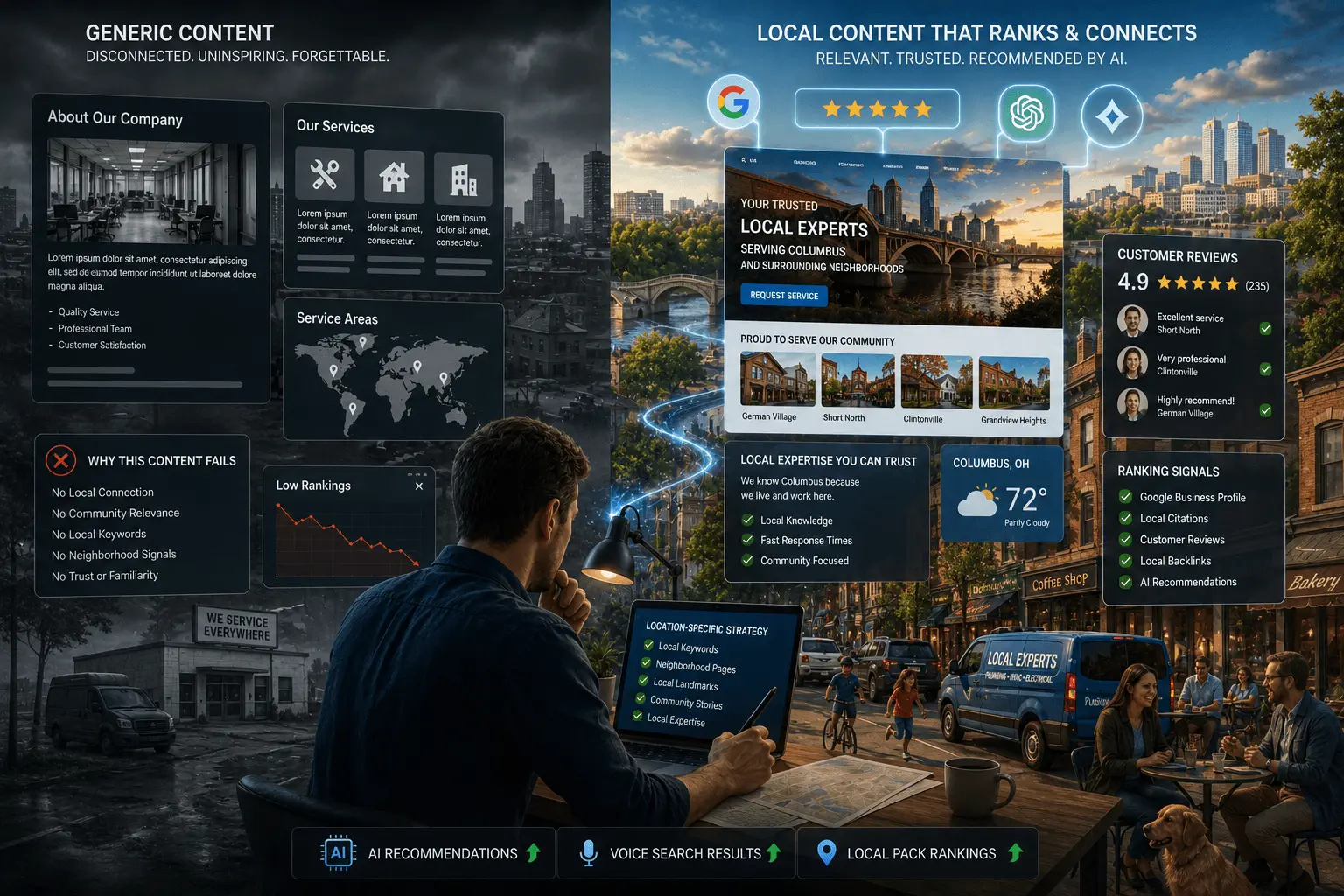
Two roofing companies in the same mid-sized city both published a page titled "Roof Replacement Cost Guide" within a few weeks of each other. One was a generic 800-word overview that could have been published by a roofer in any state: national average costs, general material types, a broad checklist. The other opened with a mention of the specific building codes in that city, referenced the hail damage patterns common to that region's storm season, and named two neighborhoods where older homes tend to need full tear-offs rather than overlays. Six months later, the second page was ranking on page one for a dozen local variations of the search term. The first page had barely moved.
That gap is hyper-local content doing exactly what it's designed to do. It's one of the more reliable ways to differentiate a service business's content from the flood of generic, interchangeable pages competing for the same searches, and it works because it solves a real gap in how most local businesses approach their websites.
What Hyper-Local Content Actually Means
Hyper-local content goes beyond simply mentioning a city name in a page title. It's content built around genuinely specific, local knowledge: neighborhood names, regional weather patterns, local building codes or regulations, common property types in that area, nearby landmarks, local events, and details a business could only know from actually operating in that community.
If you want expert help with this, explore our Local SEO Services and Map Pack Ranking — we work with service businesses across the UK, Dubai, and UAE.
The distinction that matters is between content that mentions a location and content that demonstrates knowledge of that location. "Serving Springfield and surrounding areas" mentions a location. A paragraph explaining why homes in Springfield's older east side neighborhoods tend to need a specific type of plumbing repair due to the clay pipe systems common in homes built before a certain decade demonstrates it.
Why Generic Local Content Fails
Most local service businesses know they're supposed to include their city in their content, so they do, usually by taking a generic template and swapping in the city name a handful of times. This produces exactly the kind of thin, interchangeable content that search engines have gotten increasingly good at identifying and deprioritizing.
The deeper problem is that this kind of content fails the actual customer too, not just the algorithm. A homeowner comparing three local contractors can tell within seconds which one actually seems to know their area and which one copy-pasted a national template. Generic content doesn't just rank worse. It converts worse, because it fails to build the specific, local trust that gets someone to pick up the phone instead of clicking to the next result.
Why Hyper-Local Content Ranks Better
It matches genuine relevance signals
Search engines are trying to determine which page best answers a specific, local query. A page dense with genuine local detail gives far more relevance signal than a page that mentions the city name three times and otherwise reads identically to a page written for any other city. This directly supports the relevance component of local ranking, alongside distance and prominence.
It naturally includes the semantic entities that matter
Neighborhood names, nearby landmarks, local regulations, and regional terminology all function as semantic entities that reinforce your topical and geographic relevance without needing to be forced in artificially. This tends to happen naturally when the content is written by someone who genuinely knows the area, rather than being engineered after the fact.
It earns natural engagement and links
Content specific enough to be genuinely useful to a local audience gets shared, referenced, and linked to in ways that generic content rarely does. A detailed guide to navigating a specific city's permit process for a home addition is the kind of thing a local Facebook group, a neighborhood forum, or a local news outlet might actually reference, which generic content almost never earns.
It increasingly matters for AI search visibility too
AI search tools that synthesize direct answers from source content tend to favor pages with specific, verifiable, factual detail over vague, general claims. A hyper-local page that clearly demonstrates specific knowledge of an area gives these systems more concrete, extractable, trustworthy information to draw from than a templated page that could apply anywhere.
What Genuinely Hyper-Local Content Includes
- Specific neighborhood, suburb, or district names, not just the overall city
- Regional weather, climate, or seasonal patterns relevant to your service
- Local building codes, permit requirements, or regulations that affect your industry
- Common property types or housing styles specific to that area and how they affect your service
- Nearby landmarks or well-known local reference points
- Local events, seasonal cycles, or community context relevant to when customers need your service
- Genuine local testimonials or examples, ideally naming the neighborhood or area where the work took place
- Local pricing context if it varies meaningfully from national averages, with a clear explanation of why
How to Build Hyper-Local Content Without Faking It
Talk to the people who actually work in the field
If you're not the one doing the work directly, your technicians, service providers, or field staff are sitting on genuine local knowledge you probably haven't tapped yet. Ask them what comes up repeatedly in specific neighborhoods, what local quirks they navigate regularly, and what questions customers in different areas tend to ask. This is often the fastest way to generate real hyper-local detail rather than inventing it from scratch.
Use your own job history
Past invoices, service records, and completed jobs are a goldmine of genuine local detail: which neighborhoods you've served, what kinds of issues came up, what property types were involved. This gives you real material to draw from rather than generic filler.
Research actual local regulations and conditions
Building codes, permit requirements, climate data, and similar factual, verifiable local details are publicly available and add genuine substance to a page. This is time-consuming compared to a templated approach, but it's exactly the kind of depth that separates hyper-local content from content that merely mentions a location.
Avoid inventing specifics you can't back up
Don't fabricate customer stories, invent statistics about local conditions, or claim specific local expertise you don't actually have. Hyper-local content works because it's genuinely true and verifiable. Faked specificity tends to read as slightly off to a real local audience, even if it's difficult to pin down exactly why, and it creates real risk if a customer or competitor calls out a detail that turns out to be inaccurate.
Structuring Hyper-Local Content for Multiple Areas
If you serve several distinct neighborhoods or towns, resist the urge to build twenty thin pages just to claim broad coverage. A smaller number of genuinely detailed, well-researched local pages consistently outperforms a large number of shallow ones. Prioritize the areas that drive the most business first, build those pages properly, and expand deliberately rather than all at once.
Each page should stand on its own as genuinely useful content, not as a thin wrapper pointing back to a generic main service page. If two location pages could be swapped with only the city name changed and nothing would feel wrong, that's a signal the content isn't hyper-local yet.
Hyper-Local Content Beyond Location Pages
This approach isn't limited to dedicated service area pages. Blog content, FAQ sections, and even your Google Business Profile description all benefit from the same principle. A blog post about seasonal HVAC maintenance is more useful, more differentiated, and more rankable when it's written around the specific climate patterns of your actual service area rather than generic national advice that could apply anywhere.
A Simple Test for Whether Your Content Is Actually Hyper-Local
Read a page and ask whether it would need to change meaningfully if you swapped it to a different city you don't serve. If the answer is no, beyond the city name itself, the content isn't hyper-local yet, regardless of how many times the location appears on the page. Genuinely local content should feel noticeably wrong if you tried to reuse it somewhere else, because it's built around details specific to one place.
Frequently Asked Questions
Length matters less than substance. A shorter page dense with genuine local detail outperforms a longer page padded with generic filler. Focus on depth and specificity rather than hitting a particular word count.
AI tools can help structure and draft content efficiently, but the genuine local detail, neighborhood knowledge, regulations, real job history, has to come from you or your team. An AI tool can't invent authentic local specificity on its own, and content that tries to fake it tends to read as generic despite the effort.
No. They work together. Your Google Business Profile handles a huge share of local visibility on its own, and hyper-local website content reinforces and supports that visibility rather than replacing it.
Revisit key pages at least once or twice a year to confirm local details, pricing context, and regulations are still accurate, and update more frequently if your service area, local conditions, or offerings change.
No. Any business with a defined local audience benefits, including professional services, healthcare providers, restaurants, and retail businesses. The specific details will differ, but the underlying principle of demonstrating genuine local knowledge applies broadly.
Common Mistakes That Undermine Hyper-Local Content
- Mentioning the city name repeatedly while keeping every other sentence generic enough to apply anywhere
- Copying competitor location pages and swapping in local details without genuinely verifying they're accurate for your own business
- Writing one strong flagship page and then neglecting every other service area page indefinitely
- Overloading a page with so many neighborhood names that it reads like a list rather than genuine, useful content
- Treating hyper-local content as a one-time project instead of revisiting it as local conditions, regulations, or your own service area change
Any one of these mistakes tends to water down the exact advantage hyper-local content is supposed to create. The whole point is depth and authenticity, and shortcuts that prioritize speed over accuracy usually produce something only marginally better than the generic template it was meant to replace.
Final Thoughts
Hyper-local content works because it does something generic content structurally cannot: it proves, through specific and verifiable detail, that a business genuinely understands and operates in the community it claims to serve. That roofing company from the start of this post didn't win by writing more content or by stuffing more keywords into a page. They won by including details a roofer working anywhere else simply wouldn't know to include. That's a difficult thing for competitors to copy quickly, and it's exactly why it holds up better over time than content built around a template.
What's one piece of genuine local knowledge your business has that hasn't made it onto your website yet?
Want Results Like This for Your Business?
Get a free Local SEO audit — we will show you exactly what is holding your rankings back and the fastest path to the Google map pack.
Talk to a Local SEO Specialist →