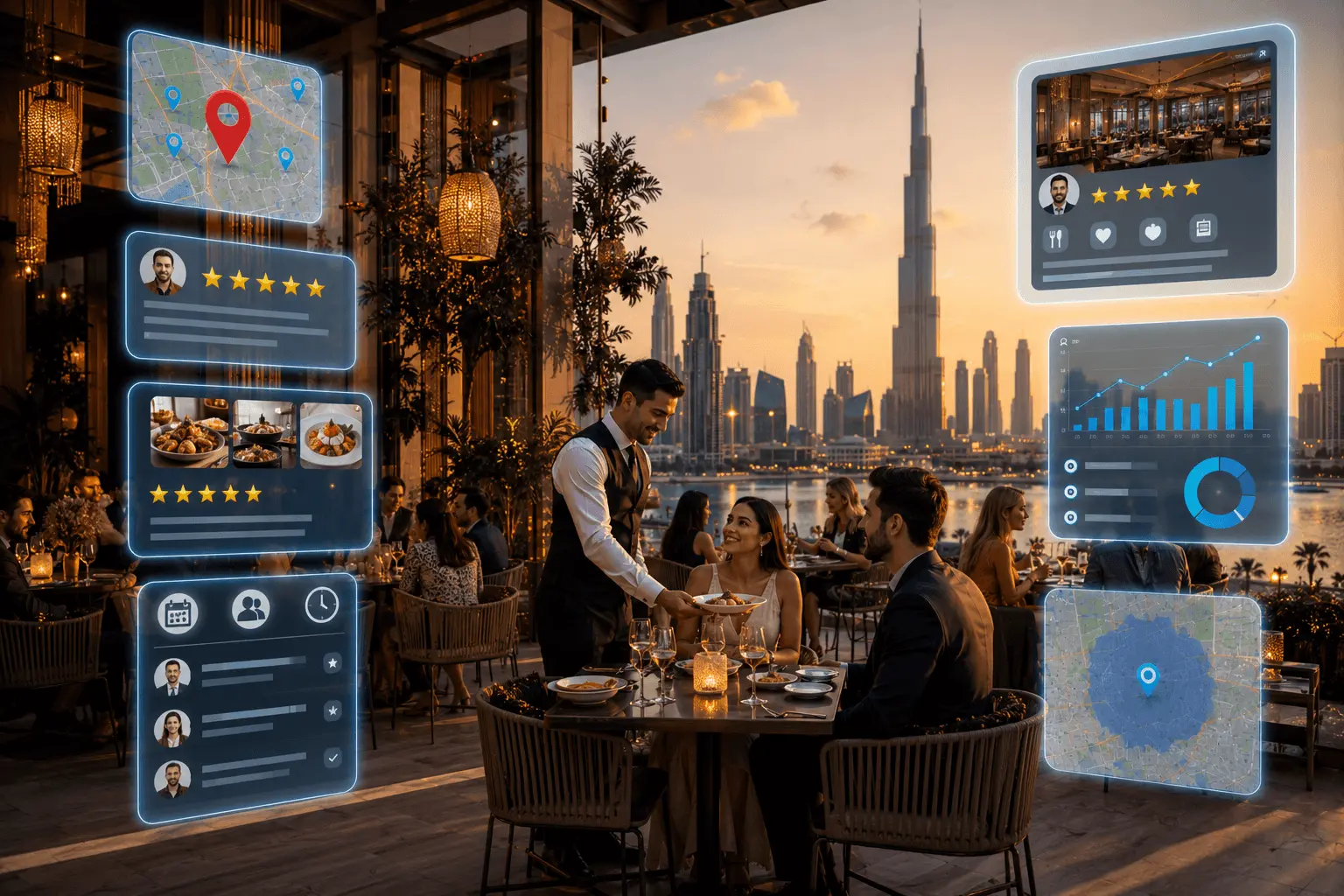
Omar had been running his Lebanese restaurant in JLT for three years when he noticed something that made him genuinely angry. A new shawarma spot opened four doors down from him in November 2023. They had no regulars, a one-page menu, and a fitout that looked like it cost about AED 30,000. By February they were ranking first on Google Maps for 'Lebanese restaurant JLT' while Omar's place, with its wood-fired oven, loyal Friday brunch crowd, and 200-plus seating capacity, sat in position seven.
He called me frustrated and confused. His food was objectively better. His prices were fair. His service team had been together for two years. How was a brand-new shawarma counter outranking him on Google?
The answer was painfully simple. The new spot had 43 Google reviews posted in their first two months, a fully completed Google Business Profile with daily photos uploaded from the kitchen, and a website with a dedicated JLT restaurant page optimized for the searches their customers were making. Omar's profile had 18 reviews spread across three years, stock photos his fitout company had uploaded at opening, and a website that had not been touched since launch.
If you want expert help with this, explore our Local SEO Services — we work with service businesses across the UK, Dubai, and UAE.
You may also find these guides useful: GMB Optimization Dubai: Dominate Google Maps, Review Management Dubai: Build Trust & Win Customers.
That gap is not about food quality. It is entirely about local SEO. And in Dubai's restaurant industry, where thousands of dining options compete for the attention of a highly mobile, review-dependent customer base, local SEO is the difference between a full dining room and a quiet Tuesday night wondering where everyone went.
This guide covers exactly how Dubai restaurants win on Google: from Google Business Profile optimization to review strategy, from keyword targeting to the seasonal content plays that keep you visible year-round across the UAE dining calendar.
Why Local SEO Is the Highest-ROI Marketing Channel for Dubai Restaurants
Dubai's restaurant market is one of the most competitive on earth. The emirate has over 13,000 licensed food and beverage outlets serving a population of roughly 3.6 million residents, plus tens of millions of annual tourists. That density means diners have genuine choice, and that choice begins almost universally with a Google search.
When a family in Business Bay decides where to eat on a Thursday evening, they are not flipping through a printed guide or asking a concierge. They are typing 'restaurants near me' or 'best brunch Business Bay' into Google on their phone while getting ready to go out. The restaurant that appears in the top three Google Maps results for that search captures the consideration. The one that also has 150 reviews averaging 4.6 stars, professional food photos, and accurate opening hours gets the booking.
The ROI case for restaurant local SEO in Dubai is straightforward. A new table booking from a Google search costs you nothing beyond the time invested in optimization. The same customer acquired through Zomato Pro or The Entertainer costs you a commission or a heavily discounted cover. Google organic visibility is the one channel that delivers high-intent customers without ongoing commission, discount, or ad spend eating into already tight restaurant margins.
Here is the insight most restaurant owners in Dubai miss: tourists and newly arrived residents rely on Google Maps more than any other source for restaurant discovery. Dubai's population turnover is significant. Thousands of new residents arrive every month who have no local dining knowledge and turn immediately to Google. A restaurant consistently ranking in the top three local pack positions for its cuisine and neighborhood captures a steady stream of these first-time searchers who then become regulars.
Google Business Profile Optimization for Dubai Restaurants
Your Google Business Profile is your restaurant's most important digital asset. It is what appears in Google Maps, what shows up in local pack results, and what potential diners see before they ever visit your website. For Dubai restaurants specifically, GBP optimization requires attention to factors that generic local SEO guides completely overlook.
Category Selection: Cuisine Specificity Wins in Dubai
Dubai diners search by cuisine far more specifically than diners in most other cities. This reflects the extraordinary diversity of the population and the sophisticated food culture the city has developed. Searches like 'Japanese restaurant DIFC,' 'authentic Indian restaurant Bur Dubai,' 'vegan cafe Dubai Marina,' and 'Filipino restaurant Deira' are high-volume, high-intent queries that generic categories like 'Restaurant' simply do not capture.
Set your primary GBP category to the most specific cuisine category Google offers for your concept. If you serve Lebanese food, use 'Lebanese Restaurant' not just 'Middle Eastern Restaurant.' If you are a Japanese omakase counter, 'Japanese Restaurant' is your primary category with 'Sushi Restaurant' as a secondary. Add every secondary category that legitimately applies: 'Halal Restaurant' if you are halal-certified, 'Vegetarian Restaurant' or 'Vegan Restaurant' if plant-based options are a significant part of your offering, 'Brunch Restaurant' if Friday brunch is a core revenue driver. Each additional relevant category expands the searches your profile appears for.
Menu Integration and Dish-Level Visibility
Google Business Profile allows restaurants to upload a full menu, and this feature has direct impact on search visibility. When someone searches 'wagyu burger Dubai' or 'truffle pasta JBR,' Google can surface restaurants whose GBP menus include those specific dishes. Most Dubai restaurants have not uploaded their menu to their GBP at all, which means they are invisible for dish-specific searches that represent some of the highest-intent queries in the food discovery funnel.
Upload your full menu with accurate item names, descriptions, and prices in AED. Update it every time your menu changes seasonally or your team introduces new dishes. If you offer a dedicated Ramadan iftar menu or a National Day set menu, upload those as temporary additions during the relevant period. A diner searching for 'iftar buffet Dubai Marina' whose query matches a dish in your uploaded menu has a meaningfully higher chance of seeing your restaurant in their results.
Photos That Convert Dubai Diners Into Bookings
Food photography standards in Dubai are high. The city's dining culture is inherently social and visual, shaped by years of Instagram-driven restaurant discovery and a customer base that treats dining out as a shareable experience. A GBP with amateur phone photos of half-lit dishes signals a restaurant that does not take its presentation seriously, which in Dubai is a serious competitive disadvantage.
Invest in a professional food photography session covering your six to eight signature dishes, your dining room at service, your bar setup if applicable, and your team in action. This investment of AED 800 to AED 2,500 depending on the photographer generates assets that work across your GBP, your website, and your social media simultaneously. Upload your best twelve to fifteen photos at launch, then maintain a rhythm of adding three to five fresh photos every two weeks. Seasonal dishes, special event setups, and new menu additions all make strong ongoing photo content.
Google's own data shows that restaurants with more than 100 photos on their GBP receive significantly more direction requests and website clicks than those with fewer than 20. In a city where diners often decide where to eat based on what looks most appealing on a screen, photo volume and quality are direct revenue drivers.
GBP Optimization Checklist for Dubai Restaurants
| GBP Element | Best Practice | Dubai-Specific Priority |
|---|---|---|
| Primary category | Most specific cuisine category | Critical: drives cuisine-specific searches |
| Secondary categories | Halal, brunch, vegan, delivery if applicable | High: Dubai diners filter by halal and brunch heavily |
| Menu upload | Full menu with AED prices, updated seasonally | High: dish-specific searches are common in Dubai |
| Photos | 15+ professional shots, 3 to 5 new every 2 weeks | Critical: visual culture drives dining decisions |
| Opening hours | Accurate including Ramadan hours | Critical: wrong hours during Ramadan cause 1-star reviews |
| Business description | Cuisine, area, ambience, key dishes in 250 chars | High: area name in first line improves local relevance |
| Google Posts | Weekly: new dishes, events, seasonal offers | Medium: DSF, Ramadan, National Day posts drive traffic |
| Attributes | Halal, outdoor seating, reservations, delivery | High: diners filter by these attributes on Maps |
Review Strategy for Dubai Restaurants: Volume, Recency, and Response
Reviews are the primary trust currency in Dubai's restaurant discovery process. A diner choosing between two similarly positioned restaurants on Google Maps will look at three things in order: the photo quality, the star rating, and the review count. In a city where diners are sophisticated, internationally traveled, and spoiled for choice, a restaurant with 200 reviews averaging 4.5 stars will almost always win the click over a competitor with 40 reviews averaging 4.7 stars. Volume signals credibility. Recency signals that the quality is consistent today, not just when the reviews were written.
Building a Review Generation System That Works in Dubai
The highest-converting moment to request a review from a Dubai restaurant diner is at the end of a positive dining experience, when the bill arrives or immediately after dessert. Train your floor staff to make the request genuinely and personally. A server saying 'We would really appreciate it if you could share your experience on Google, it means a lot to our small team' converts at a much higher rate than a printed card on the table asking for reviews that diners ignore before they even sit down.
Provide a QR code on your bill folder or receipt that opens your Google review page directly. Friction kills review conversion. Every additional step a diner has to take between feeling good about their meal and posting a review loses you 30 to 40 percent of willing reviewers. A QR code that opens the review box in two taps is the minimum friction setup that Dubai's mobile-first diners will actually use.
For delivery orders, include a small card in every bag with a review QR code and a personal note from the kitchen. Delivery customers who had a great experience are often more motivated to leave a review because they feel a connection to the food itself rather than the ambient experience of the room. A Lebanese restaurant in Al Barsha I worked with generated 34 new Google reviews in six weeks purely from delivery order review requests, moving their average rating from 4.1 to 4.5 in the process.
Responding to Reviews Across Dubai's Multicultural Dining Audience
Dubai restaurant reviews arrive in English, Arabic, Hindi, Urdu, Russian, Chinese, Tagalog, and a dozen other languages depending on your location and cuisine. Responding in the reviewer's language where possible signals genuine hospitality, which is the core promise of any restaurant. Use Google Translate for draft responses in languages your team does not speak natively, then have a team member review for tone before posting.
For negative reviews, the standard rule applies with extra urgency in Dubai: respond within 24 hours, stay brief and professional, take the resolution offline immediately, and never argue facts in public. Dubai's dining community is small and well-connected despite the city's size. A restaurant owner who publicly disputes a reviewer's account gets talked about in expat Facebook groups and building WhatsApp chats in ways that compound the original damage significantly.
Keyword Strategy: How Dubai Diners Actually Search for Restaurants
Understanding the search patterns specific to Dubai dining unlocks the keyword strategy that drives real traffic. Dubai diners search differently from diners in London, New York, or even Abu Dhabi. The patterns reflect the city's unique geography, its cultural composition, and its dining culture.
The most valuable search pattern for Dubai restaurants is cuisine plus area. 'Italian restaurant Downtown Dubai,' 'Thai food JLT,' 'Indian restaurant Karama,' 'sushi Marina,' and 'Filipino restaurant Deira' are high-volume, high-intent searches with clear commercial purpose. Your GBP categories, business description, and website content should be optimized for the specific cuisine-area combination that defines your restaurant.
The second pattern is experience-type searches. 'Brunch Dubai' is one of the highest-volume restaurant searches in the emirate, driven by the Friday brunch culture that is unique to Dubai and the wider UAE. 'Friday brunch JBR,' 'best brunch with pool access Dubai,' 'family brunch Dubai,' and 'unlimited brunch Dubai' all represent searchers with very specific intent and high spending willingness. If brunch is part of your offering, optimizing specifically for brunch searches is worth dedicated attention on both your GBP and your website.
Seasonal and Event-Based Keywords Worth Targeting
Dubai's dining calendar has predictable peaks that smart restaurants anticipate with their SEO content. Ramadan is the single most important seasonal period for food and beverage businesses, with searches for 'iftar Dubai,' 'suhoor restaurant Dubai,' 'Ramadan buffet,' and 'iftar deals near me' spiking dramatically in the weeks before and during the holy month. A restaurant that publishes a dedicated Ramadan menu page on its website in March, before Ramadan begins, and updates its GBP with Ramadan-specific hours and offerings, captures those searches before competitors react.
Dubai Food Festival, which typically runs in February and March, generates significant search volume for restaurant discovery. Dubai Shopping Festival in January drives searches for dining deals and festive dining experiences. National Day in December prompts searches for themed dining events. Each of these represents a window where proactive content and GBP updates capture intent that competitors with a passive approach completely miss.
High-Value Search Terms for Dubai Restaurants by Category
| Search Type | Example Queries | When to Optimize |
|---|---|---|
| Cuisine plus area | Lebanese restaurant JLT, sushi DIFC, Indian Karama | Always, year-round core priority |
| Experience type | Brunch Dubai Marina, rooftop dining Downtown, family restaurant Dubai | Year-round with seasonal emphasis |
| Ramadan specific | Iftar Dubai, suhoor restaurant, Ramadan buffet near me | Optimize in February, peak in March to April |
| Occasion dining | Birthday dinner Dubai, anniversary restaurant, private dining Dubai | Year-round, Valentine's Day spike in February |
| Delivery specific | Food delivery JLT, best delivery Dubai Marina, late night delivery Dubai | Year-round, summer peak June to August |
| Tourist driven | Best restaurant near Burj Khalifa, Dubai Mall dining, restaurants near JBR beach | Year-round, peak October to April |
Your Restaurant Website: The SEO Foundation That Amplifies Your GBP
Many Dubai restaurant owners treat their website as a digital brochure that exists because it should, not because it does anything useful. That mindset is the gap that local SEO closes. A well-structured restaurant website actively earns organic search traffic for every cuisine-area and experience-type search your customers make, capturing searchers who scroll past the local pack or want more information before booking.
The Pages Every Dubai Restaurant Website Needs
Beyond a homepage, a menu page, and a contact page, Dubai restaurants should have dedicated pages for every distinct offering that generates its own search demand. A Friday brunch page optimized for brunch-specific searches. A private dining and events page for corporate and occasion bookings. A delivery page if you offer delivery, separate from your dine-in content. If you have a terrace or rooftop, a dedicated outdoor dining page captures the significant search volume for alfresco dining in Dubai's cooler months from October through April.
Each page should include the specific experience or offering in its title tag and H1, your restaurant name, your area, and at least 400 words of genuine content that answers the questions a potential diner would have: what is included, what does it cost, how do you book, and what makes it worth choosing you over the dozens of competitors offering something similar nearby.
Structured Data: The Technical Edge Most Dubai Restaurants Miss
Restaurant structured data markup is code added to your website that tells Google specific information about your business in a format it can display directly in search results. Adding restaurant schema markup to your website allows Google to show your star rating, price range, cuisine type, and opening hours directly in search results without the user needing to visit your site or your GBP. This rich snippet appearance increases click-through rates meaningfully.
Most Dubai restaurant websites have no structured data at all, which makes implementing it a straightforward competitive advantage. If your website runs on WordPress, plugins like Rank Math or Yoast SEO handle restaurant schema with minimal technical configuration. If your site is custom-built, share the structured data specification with your developer. The implementation takes two to three hours and the visibility benefit is permanent.
Citation Building and Online Directory Presence for Dubai Restaurants
Beyond Google, Dubai diners discover restaurants through a specific set of platforms that carry both direct referral traffic and indirect SEO value through citation links. Your restaurant's name, address, phone number, and website URL should be consistent across every platform where your business appears.
The essential platforms for Dubai restaurant citations are Google Business Profile, Zomato, TripAdvisor, Yelp, Facebook Business, OpenTable or Sevenrooms if you take reservations, Deliveroo and Talabat if you offer delivery, and Time Out Dubai's restaurant listings. Each platform carries its own audience and referral traffic, but collectively they also send Google consistent signals about your business information that strengthen your local search authority.
The consistency rule is absolute. If your restaurant is listed as 'Omar's Lebanese Kitchen' on Google but 'Omars Lebanese Kitchen' on Zomato and 'Omar Lebanese Restaurant' on TripAdvisor, those inconsistencies create conflicting data that Google treats as a trust signal problem. Audit every platform where your restaurant appears and standardize your business name, address format, phone number, and website URL exactly. Even small variations in how your address is written matter to the algorithm.
Tracking Local SEO Performance for Your Dubai Restaurant
Measurement tells you what is working so you can do more of it and what is wasting time so you can stop. For Dubai restaurants, the metrics that matter most are more specific than generic local SEO tracking.
Track your Google Business Profile insights weekly during peak periods and monthly during slower summer months. The key numbers are calls placed directly from your GBP, direction requests, website clicks, and photo views. A restaurant that sees high photo views but low call conversions likely has strong visual content but weak review volume or a rating below 4.3, which is where conversion rates drop sharply in Dubai's discerning dining market.
Monitor your local pack ranking position for your five most important search terms using BrightLocal or Local Falcon, set to your restaurant's specific address location in Dubai. Check rankings at the beginning of each month and note changes relative to the actions you took in the preceding four to six weeks. This correlation between actions and results is how you learn which optimization activities have the highest impact in your specific market and competitive set.
The most honest performance metric remains the simplest: ask every new table how they found you. In Dubai, where diners often book spontaneously on the same day, the answer 'Google Maps' or 'searched online' directly measures your local SEO effectiveness in language that connects to revenue, not just rankings.
Frequently Asked Questions About Local SEO for Dubai Restaurants
Independent restaurants actually have a structural advantage over chains in local pack rankings because Google's algorithm favors relevance and proximity over brand size. A single-location Lebanese restaurant in JLT that has 150 genuine reviews, a fully optimized GBP with weekly posts, and location-specific website content will consistently outrank a chain with 20 Dubai locations whose individual location profiles are maintained inconsistently by a central marketing team. Focus on review velocity, GBP activity, and neighborhood-specific content. Those are the levers an independent restaurant can pull more effectively than any chain.
Yes, for two distinct reasons. First, each platform carries its own audience that may not overlap significantly with your Google traffic. TripAdvisor reaches international tourists who rely on it specifically for restaurant research before and during Dubai visits. Zomato has a loyal UAE-resident user base that trusts its reviews for everyday dining decisions. Second, active listings on these platforms create citation links that contribute to your Google local search authority. Maintain accurate, complete profiles on both platforms and respond to reviews on each, just as you do on Google.
Update your Google Business Profile hours for Ramadan before the month begins, not during it. Set your special hours for the Ramadan period using the 'Special Hours' feature in your GBP dashboard. This prevents Google from showing incorrect hours to searchers and avoids the one-star reviews that arrive when diners show up to a closed restaurant based on outdated information. Also update your hours on Zomato, TripAdvisor, Deliveroo, Talabat, and your website simultaneously. Inconsistent hours across platforms during Ramadan is one of the most common and easily preventable reputation damage events for Dubai restaurants.
Delivery and dine-in searches have different keyword patterns and different conversion journeys but draw from the same local SEO foundation. Delivery-specific searches like 'food delivery JLT,' 'late night delivery Dubai Marina,' and 'healthy delivery Dubai' have strong search volume, particularly during summer months when Dubai residents prefer to stay indoors. A dedicated delivery page on your website optimized for delivery-specific terms, combined with active profiles on Deliveroo and Talabat that link back to your website, captures this audience effectively. Your GBP should also clearly indicate delivery availability in your attributes and services sections.
In most Dubai neighborhood searches, the top three local pack positions are held by restaurants with 80 to 300 reviews averaging 4.4 stars or higher. The exact threshold varies by area and cuisine category. A Filipino restaurant in Deira may rank in the top three with 60 reviews because the competition is less saturated. A brunch restaurant in Dubai Marina may need 200 or more reviews to break into the top three given the density of competition. More important than hitting a specific number is maintaining review recency. A restaurant receiving five or more new reviews per month signals an actively popular business to Google's algorithm, which supports rankings more sustainably than a one-time review push that then stops.
Start This Week and Fill Your Tables Through Google
Omar's Lebanese restaurant in JLT now ranks second on Google Maps for his primary search terms. It took him about five months of consistent work: completing his GBP fully, uploading professional food photos every two weeks, training his floor staff to request reviews at the end of every positive meal, responding to every review within 24 hours, and publishing a Ramadan menu page on his website six weeks before the holy month began. His new customer walk-ins attributed to Google Maps doubled within the first three months. By month five they had tripled.
The shawarma spot that beat him initially? It peaked fast on reviews and then stopped generating them. Its average rating dropped as volume leveled off and a few negative experiences went unanswered. Omar passed it in the rankings in month four and has not looked back.
Dubai's restaurant market rewards consistency above everything else. The restaurants that win on Google are not necessarily the ones with the best food, the biggest marketing budgets, or the most prominent locations. They are the ones that treat their Google presence as seriously as they treat their kitchen, updating it regularly, responding to feedback promptly, and giving Google every signal it needs to recommend them to the next hungry diner searching nearby.
Start this week with three actions. Complete every empty field in your Google Business Profile today, with particular attention to your cuisine categories, menu upload, and attributes like halal certification and outdoor seating. Upload ten high-quality food photos if your current count is below that. And brief your floor team this week on how and when to request Google reviews from diners who have had a great experience.
Those three actions before the week ends will move your restaurant ahead of the majority of your Dubai competitors. Everything else in this guide compounds on that foundation over the months that follow.
Which neighborhood are you trying to dominate on Google Maps, and who is currently ranking above you? Drop it in the comments and let us figure out exactly what it would take to get there.
Want Results Like This for Your Business?
Get a free Local SEO audit — we will show you exactly what is holding your rankings back and the fastest path to the Google map pack.
Talk to a Local SEO Specialist →