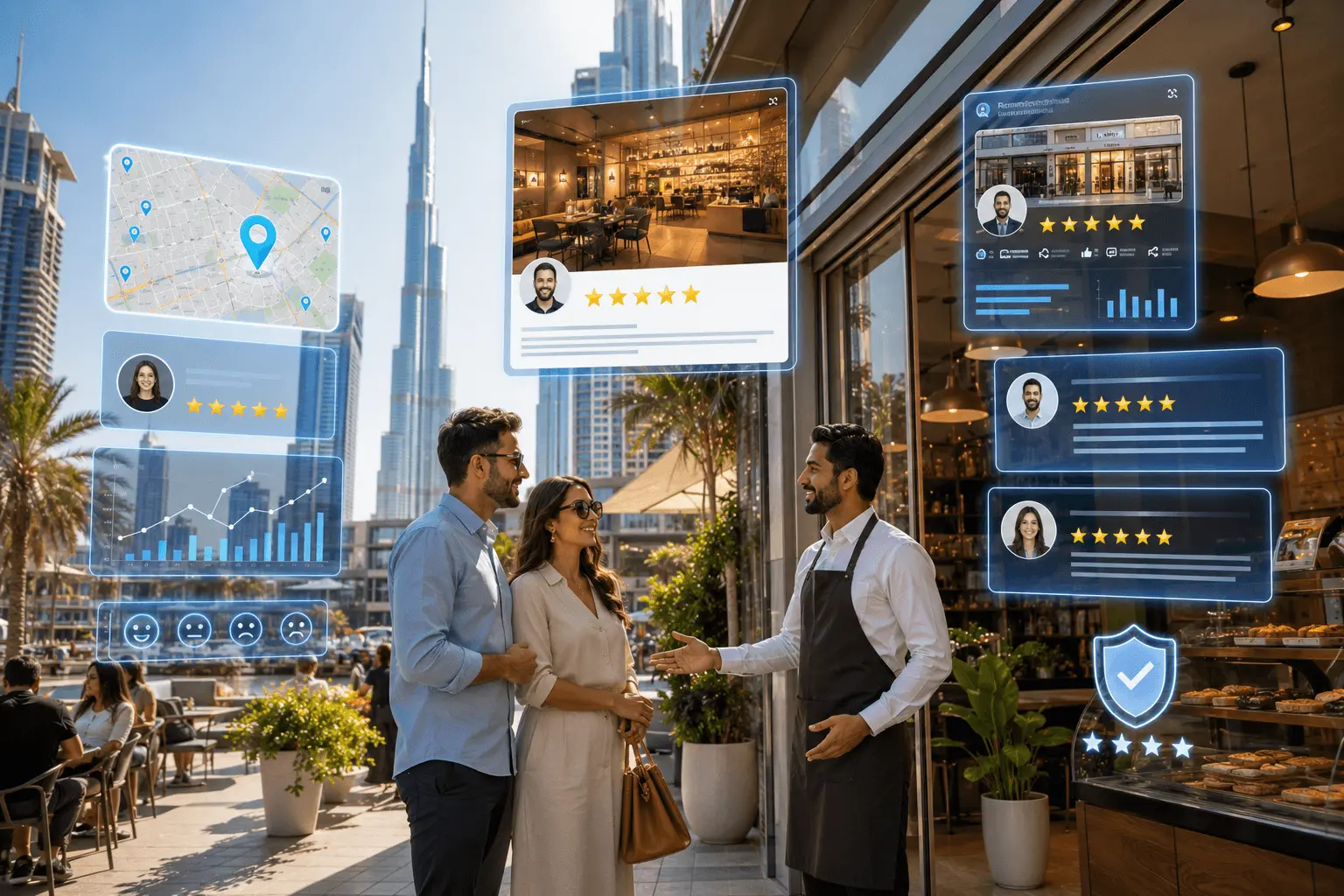
Tariq had been running his car detailing business in Dubai for six years. He had a loyal base of repeat clients, a spotless workshop in Al Quoz, and a team of four trained technicians. His business did not grow much beyond referrals, which was fine until two new competitors opened nearby in the space of four months. Both were newer, smaller, and objectively less experienced than Tariq's operation.
By the end of their first quarter, one of those competitors had 67 Google reviews averaging 4.9 stars. The other had 51 reviews averaging 4.7 stars. Tariq's six-year-old business had 14 reviews averaging 4.2 stars, three of which he had not responded to, including one two-star review from eight months earlier that simply sat there unanswered for anyone searching his business name to read.
He was not losing customers because of his work quality. He was losing them at the moment of discovery, before they ever contacted him, because his online reputation told a different story from the truth of his business. In Dubai's search-driven market, that gap between reality and online perception is the gap that review management closes.
If you want expert help with this, explore our Review Management — we work with service businesses across the UK, Dubai, and UAE.
You may also find these guides useful: GMB Optimization Dubai: Dominate Google Maps, How to Get More Google Reviews | Local Business.
This guide covers everything Dubai businesses need to know about managing reviews effectively: how to generate them consistently, how to respond to them across a multicultural customer base, how they influence your Google Maps rankings, and how to handle the specific reputation challenges that arise in Dubai's uniquely competitive and internationally diverse business environment.
Why Review Management Hits Different for Dubai Businesses
Dubai is not a standard local business environment. Several characteristics of the city make review management both more impactful and more complex than in most markets worldwide. Understanding these characteristics shapes every decision you make about how to generate, monitor, and respond to customer reviews.
The first characteristic is population transience. Dubai has one of the highest population turnover rates of any major city on earth. Thousands of residents arrive every month who have no local knowledge, no established service providers, and no community word-of-mouth network to tap. These new arrivals rely on Google reviews almost entirely to make decisions about which businesses to trust. A new resident searching for a car detailer, a clinic, a restaurant, or a cleaning service in their neighbourhood is going to choose the business with the strongest review profile, full stop. That dynamic makes reviews the primary acquisition channel for new-to-Dubai customers.
The second characteristic is the multicultural decision-making environment. Dubai's customer base spans more than 200 nationalities, each of which brings different expectations, communication styles, and trust signals to their purchasing decisions. A review that persuades a British expat may not persuade an Indian professional or a Russian tourist. Review management in Dubai means building a profile that communicates trust across cultural contexts simultaneously, which requires both volume and diversity of reviewer backgrounds.
The third characteristic is the speed at which reputation spreads. Dubai's expat community is intensely connected through WhatsApp groups, neighbourhood Facebook groups, and community platforms like Meetup. A single unresolved negative review or a poorly handled complaint can circulate through these networks within hours in ways that have no equivalent in less connected cities. Review management in Dubai is not just about what appears on Google. It is about what those Google reviews trigger in the offline conversation networks that run parallel to them.
Building a Review Generation System That Works in Dubai
Most Dubai businesses generate reviews passively, which means they generate almost none. A customer has a great experience, feels satisfied, and moves on with their day without the thought of leaving a review crossing their mind. Your job is to create the moment and the mechanism that makes leaving a review the natural next step after a positive experience.
The Timing Principle That Doubles Review Conversion
The single most important factor in review generation is timing. Reviews are most likely to be written in the 24 to 48 hours immediately following a positive experience, while the specifics are still vivid and the emotional satisfaction is still present. A review request that arrives three weeks after the service, when the customer has moved on mentally and the experience has blurred into general memory, converts at a fraction of the rate of a request sent within 24 hours.
Map out the moments of peak satisfaction in your customer journey and make your review request at the closest possible point to one of those moments. For a restaurant, that moment is when the bill arrives after a meal the customer has visibly enjoyed. For a clinic, it is at checkout after a successful appointment. For a home services business, it is in the text message sent to confirm job completion. For a retail business, it is on the receipt or in the follow-up message the day after purchase. The closer the request is to the peak satisfaction moment, the higher the conversion rate.
The QR Code and Direct Link Setup Every Dubai Business Needs
Friction kills review conversion. Every additional step between a customer's intention to leave a review and the review box appearing on their screen loses you a meaningful percentage of willing reviewers. Dubai's mobile-first customer base expects to accomplish things in two or three taps on their phone. A review process that requires searching for your business on Google, finding your listing, and navigating to the review section is too many steps for the majority of customers who would otherwise have left you a positive review.
Create a direct Google review link using the review link generator in your Google Business Profile dashboard. This link opens the review box for your business directly, with no navigation required. Shorten it using Bitly or Google's own short link tool. Turn it into a QR code using any free QR code generator. Place that QR code on your reception desk, your invoice, your delivery packaging, your staff uniforms if appropriate, and in every follow-up message you send. The businesses in Dubai consistently generating the most reviews are not doing anything more sophisticated than this. They are just making the process as effortless as possible for customers who are already disposed to leave a positive review.
WhatsApp Review Requests: Dubai's Most Effective Channel
WhatsApp is the primary communication channel for business-to-customer messaging in the UAE. Most Dubai businesses communicate with customers through WhatsApp before, during, and after a service. That existing channel is the most effective medium for review requests in this market because it meets customers where they already are rather than asking them to check an email or notice a card on a counter.
A WhatsApp message sent within two hours of job completion that says 'Hi [name], great to have you in today. If you have a moment, a quick Google review would mean the world to us. Here is the direct link: [link]' converts at a significantly higher rate than any printed card or email follow-up. Keep the message short, personal, and include the direct link without making the customer hunt for it. A cleaning company in Jumeirah implemented this approach across their 47 active clients in January 2025 and generated 29 new Google reviews in three weeks, pushing their average rating from 4.1 to 4.6 and their local pack position from fifth to second for their primary search term.
Review Generation Channels for Dubai Businesses: Effectiveness Comparison
| Channel | Conversion Rate | Best For | Dubai-Specific Note |
|---|---|---|---|
| In-person request with QR code | Very High | Retail, F&B, clinics, salons | Works best when staff make it personal, not mechanical |
| WhatsApp direct link | Very High | All service businesses | Primary channel in UAE; highest open rate of any medium |
| SMS with direct link | High | Home services, delivery | Use for customers not on WhatsApp Business |
| Email follow-up | Medium | Corporate clients, B2B services | Lower open rates but appropriate for professional context |
| Printed QR code on receipt | Low to Medium | Retail, F&B | Passive; works best alongside a verbal request |
| Social media prompt | Low | All businesses | Reach is broad but intent to review is low |
Responding to Reviews in Dubai's Multicultural Environment
Review responses in Dubai require a level of cultural sensitivity and linguistic awareness that generic review management advice completely ignores. Your response to a review is not just a conversation with the original reviewer. It is a public statement read by every potential customer who visits your profile, and in Dubai that audience spans dozens of nationalities simultaneously.
Responding Across Languages Without Losing Authenticity
Reviews in Dubai arrive in Arabic, English, Hindi, Urdu, Tagalog, Russian, Chinese, French, and dozens of other languages depending on your location and customer base. Responding only in English to reviews written in other languages signals that your business primarily values English-speaking customers, which is a significant missed opportunity in a city where English speakers are a minority of the total population.
Responding in the reviewer's language, even imperfectly, signals genuine hospitality and cultural respect that resonates deeply across every culture represented in Dubai. Use Google Translate to draft responses in languages your team does not speak natively. For Arabic specifically, review the translation with a native speaker before posting if possible, as Gulf Arabic has specific expressions and conventions that direct translation tools sometimes miss. A response in imperfect Hindi is still warmer and more appreciated by a Hindi-speaking reviewer than a polished English response that makes them feel like an afterthought.
For positive reviews, match the warmth of the reviewer's tone. For negative reviews, keep responses calm, brief, and professional regardless of the language used. The same principles of taking issues offline, avoiding public arguments, and focusing on resolution apply in every language. The only thing that changes is the medium, not the approach.
Positive Review Responses That Do Double Duty
Most Dubai businesses either ignore positive reviews entirely or respond with a generic template that reads identically to their last fifty responses. Both approaches waste a significant opportunity. A thoughtful, specific response to a positive review does two things simultaneously: it reinforces the loyalty of the reviewer who feels genuinely acknowledged, and it adds keyword-rich, locally relevant text to your Google Business Profile that contributes to your local search visibility.
When responding to a positive review, reference the specific service or experience the reviewer mentioned, use your business name and area naturally, and close with a forward-looking statement that invites a return visit. 'Thank you, Fatima. We are so glad your facial treatment at our Jumeirah salon met your expectations. Our team works hard to make every visit feel personal and we look forward to seeing you again next month.' That response took thirty seconds to write and contains your business type, your location, and a specific service mention that adds genuine SEO value while feeling completely natural.
Negative Review Responses: The Dubai Reputation Stakes Are Higher
A poorly handled negative review in Dubai can damage a business far beyond the Google profile where it appears. As noted earlier, Dubai's expat community networks through WhatsApp groups and neighbourhood Facebook communities where business recommendations and warnings spread rapidly. A business owner who responds defensively or aggressively to a negative review online is not just damaging their Google ranking. They are creating content that gets screenshotted and shared in those offline networks, compounding the damage in ways that are nearly impossible to undo.
The four-part response framework applies with extra urgency in Dubai. Acknowledge the experience without admitting liability. Apologise sincerely for falling short of expectations. Invite the reviewer to contact you directly with your name and number. Keep the response under five sentences. Never argue facts in public, even when you have evidence the reviewer is wrong. The audience watching your response is not the reviewer. It is the next thousand people who visit your profile, and they are judging your character far more than they are judging the original complaint.
One situation unique to Dubai: reviews from customers whose expectations were shaped by the city's reputation for luxury service. A customer who paid mid-market prices but expected five-star treatment is not uncommon in a city where expectations can run significantly ahead of price points. Acknowledge that they expected more, note what your service is designed to deliver, and invite them to discuss their experience privately. Never reference pricing or comparisons in a public response.
Review Response Framework by Star Rating for Dubai Businesses
| Star Rating | Goal | Tone | Key Action | Dubai-Specific Note |
|---|---|---|---|---|
| 5 stars | Reinforce loyalty and add SEO value | Warm, personal | Reference specific service and location | Respond in reviewer's language where possible |
| 4 stars | Understand the gap, invite return | Grateful and curious | Ask what would have earned a fifth star | Four-star reviews signal room to improve; take feedback seriously |
| 3 stars | Win them back, show accountability | Professional, solution-focused | Acknowledge specific criticism directly | WhatsApp follow-up to resolve privately is effective in UAE |
| 2 stars | Limit damage, demonstrate professionalism | Calm, empathetic | Provide direct contact and take offline fast | Speed matters; respond within 4 hours if possible in Dubai |
| 1 star | Signal professionalism to future readers | Measured, non-defensive | Brief acknowledgement, direct contact, never argue | Never reference competitor comparisons or Dubai cultural context publicly |
How Reviews Directly Impact Your Google Rankings in Dubai
Review management is not just a customer service activity. In Dubai's competitive local search environment it is a direct ranking lever that influences where your business appears on Google Maps and in local pack results. Understanding the mechanism helps you prioritise the right aspects of your review strategy for maximum impact on both reputation and visibility.
Google's local ranking algorithm uses review signals in two primary ways. First, your aggregate star rating and total review count contribute to your prominence score, which is one of the three pillars of local search ranking alongside relevance and distance. A business with 200 reviews averaging 4.6 stars has a significantly higher prominence score than a competitor with 30 reviews averaging 4.4 stars, assuming other factors are comparable. That prominence advantage translates directly into local pack ranking positions.
Second, review recency matters more than most businesses realise. Google weights recent reviews more heavily than older ones in its ranking calculations. A business that generated 100 reviews two years ago and has received only five in the past six months signals declining activity to Google's algorithm. A business consistently generating eight to twelve new reviews per month signals ongoing customer satisfaction and active business operations. That recency signal is one of the most reliable ongoing ranking levers available to local businesses in Dubai's competitive map search environment.
Review Keywords and Their SEO Impact
The words customers use in their reviews are indexed by Google and contribute to your search relevance for specific terms. When multiple reviewers mention 'car detailing Al Quoz' or 'best facial in Jumeirah' or 'reliable AC maintenance Dubai Marina,' those phrases strengthen your profile's relevance for exactly those searches. You cannot control what customers write, but you can influence it indirectly.
When requesting reviews, a subtle prompt can encourage location and service specificity without coaching the reviewer. A WhatsApp message that says 'We would love to hear about your experience with our detailing service in Al Quoz' gently frames the context without instructing the reviewer what to write. The resulting reviews tend to naturally include more specific, locally relevant language than reviews generated by a generic 'please leave us a review' request. Over time, the cumulative effect of location and service-specific review content meaningfully strengthens your GBP's relevance for those local searches.
Monitoring Reviews Across Multiple Platforms in Dubai
Google is the primary review platform for local search visibility in Dubai, but it is not the only platform where your business reputation lives. Depending on your industry, reviews on Zomato, TripAdvisor, Trustpilot, Facebook, Talabat, and industry-specific platforms like Houzz or Dubizzle all carry weight with different customer segments and contribute to the overall online reputation that potential customers encounter when researching your business.
A restaurant with 180 Google reviews averaging 4.6 stars but 12 Zomato reviews averaging 3.8 stars has a reputation gap that sophisticated Dubai diners will notice. A home services company with strong Google reviews but zero presence on Dubizzle misses the significant segment of customers who use that platform to find and vet tradespeople. Review management in Dubai means monitoring and maintaining your reputation across every platform where your target customers are making decisions, not just Google.
Set up Google Alerts for your business name to catch any mentions across the web. Use a tool like BrightLocal, Podium, or Reputation.com to monitor review platforms centrally rather than checking each one individually. Most of these tools also flag new reviews in real time so you can respond within hours rather than discovering a negative review days after it was posted. In Dubai's fast-moving social networks, a 24-hour response window is the maximum acceptable delay for any review. A four-hour response window for one and two-star reviews is the standard the best-managed businesses in this market maintain.
Handling Fake and Competitor Reviews in Dubai
Fake reviews are a genuine problem in Dubai's business environment. The city's competitive intensity and the significant financial stakes of winning or losing customers in high-value categories like real estate, clinics, restaurants, and professional services create an incentive for bad actors to use fake reviews as a competitive weapon. If you receive a one-star review from someone you have no record of serving, or a cluster of negative reviews arrives within a short period from accounts with no review history, fake reviews are a real possibility.
The response strategy for suspected fake reviews is the same as for any negative review: calm, professional, brief, and focused on resolution rather than accusation. Do not accuse the reviewer of being fake or a competitor plant in your public response, even if you have strong reason to believe this is the case. That public accusation makes you look paranoid to neutral observers and rarely results in removal. Instead, respond professionally, then report the review to Google through the flag function in your GBP dashboard with a detailed explanation of why you believe it violates Google's policies. Document your case with any evidence you have.
Google removes reviews that violate their policies, including reviews from people who were not genuine customers, but the process can take two to six weeks and is not guaranteed. While you wait, your professional public response demonstrates to the thousands of potential customers reading your profile that your business handles adversity with composure. That composure itself is a trust signal that partially offsets the damage of the fake review.
Frequently Asked Questions About Review Management in Dubai
The threshold varies significantly by industry and location. In high-competition categories like restaurants in Dubai Marina, clinics in Business Bay, or salons in Jumeirah, the top three local pack positions are typically held by businesses with 100 to 400 reviews averaging 4.4 stars or higher. In lower-competition categories or outer residential areas like Mirdif or Al Barsha, 40 to 80 reviews with a 4.5-plus average is often enough to rank in the top three. More important than hitting a specific number is maintaining consistent review velocity. A business generating six to ten new reviews per month signals ongoing activity to Google's algorithm more effectively than one that reached 200 reviews two years ago and has generated almost none since.
Yes, and you should when the reviewer wrote in Arabic. Responding in the reviewer's language is a signal of genuine hospitality that resonates far beyond the individual reviewer. Potential customers reading your reviews, regardless of their own language, notice when a business takes the time to respond appropriately to customers from different backgrounds. In Dubai specifically, Arabic-speaking customers command significant spending power across every business category, and a business that visibly values Arabic-speaking customers builds a broader and more loyal customer base than one that responds only in English.
First, document everything. Screenshot the reviews with timestamps, note the reviewer account details, and check whether those accounts have reviewed other businesses in your category with suspicious patterns. Second, respond to each review professionally and briefly using your standard negative review response framework, without referencing your suspicion of competitor involvement. Third, report each suspected fake review to Google through the flag function with specific policy violation explanations. Fourth, if the pattern is systematic and causing significant business damage, consult a local legal professional about options under UAE cyber laws, which take online business defamation seriously. Do not attempt to retaliate by leaving fake reviews on the competitor's profile. This violates Google's policies and UAE regulations and exposes you to far greater risk than the original problem.
For businesses with fewer than 50 reviews across all platforms and a single location, manual management through each platform's native interface is entirely workable. For businesses with multiple locations, high review volume, or reviews across five or more platforms, a dedicated tool saves significant time and reduces the risk of missed reviews. Tools like Podium, Birdeye, and Reputation.com are widely used by Dubai businesses for centralised review monitoring and response management. These tools typically cost AED 400 to AED 1,500 per month depending on features and location count. At that price, they pay for themselves if they prevent even one or two negative reviews from going unanswered each month and compounding into lost business.
Re-engagement review requests work best when they are personal and contextual rather than generic. A WhatsApp message to a customer you served three months ago that says 'Hi [name], it was great to have you with us for [service] back in March. We are building our Google reviews and your feedback would genuinely mean a lot to us. Here is a direct link if you have a moment' converts better than a mass email blast asking past customers for reviews. The personal reference to their specific service, combined with the honest context of building your review presence, lands as genuine rather than automated. Limit re-engagement requests to customers who had clearly positive experiences. Reaching out to customers you are uncertain about is a risk not worth taking.
Start Your Dubai Review Management System This Week
Tariq's car detailing business in Al Quoz now has 94 Google reviews averaging 4.7 stars. He ranks second in the local pack for his primary search terms, ahead of both competitors who briefly outranked him. His review generation system is simple: his team sends a WhatsApp message with a direct review link within two hours of every completed job, and Tariq personally responds to every review within 24 hours. That system takes his team about ten minutes per day to maintain and has transformed how new customers discover and choose his business.
Review management in Dubai is not a complex or expensive undertaking. It is a consistent discipline applied through the right channels with the cultural awareness that this specific market demands. The businesses winning on Google Maps in Dubai's most competitive categories are not necessarily the best at what they do. They are the best at making their quality visible to the customers who have not yet experienced it.
Start this week with three actions. Generate your direct Google review link from your GBP dashboard and create a QR code from it today. Send a WhatsApp review request to the last ten customers who had a positive experience with your business. And respond to every unanswered review currently sitting on your Google profile, positive and negative, before the week ends.
Those three actions cost you nothing but time and will move your review profile ahead of the majority of your Dubai competitors before you have spent a single dirham on paid marketing. Everything else in this guide builds on that foundation as your system compounds over the weeks and months ahead.
What is the biggest review management challenge your Dubai business is currently facing? Share it in the comments and let us work through the best approach for your specific situation.
Want Results Like This for Your Business?
Get a free Local SEO audit — we will show you exactly what is holding your rankings back and the fastest path to the Google map pack.
Talk to a Local SEO Specialist →