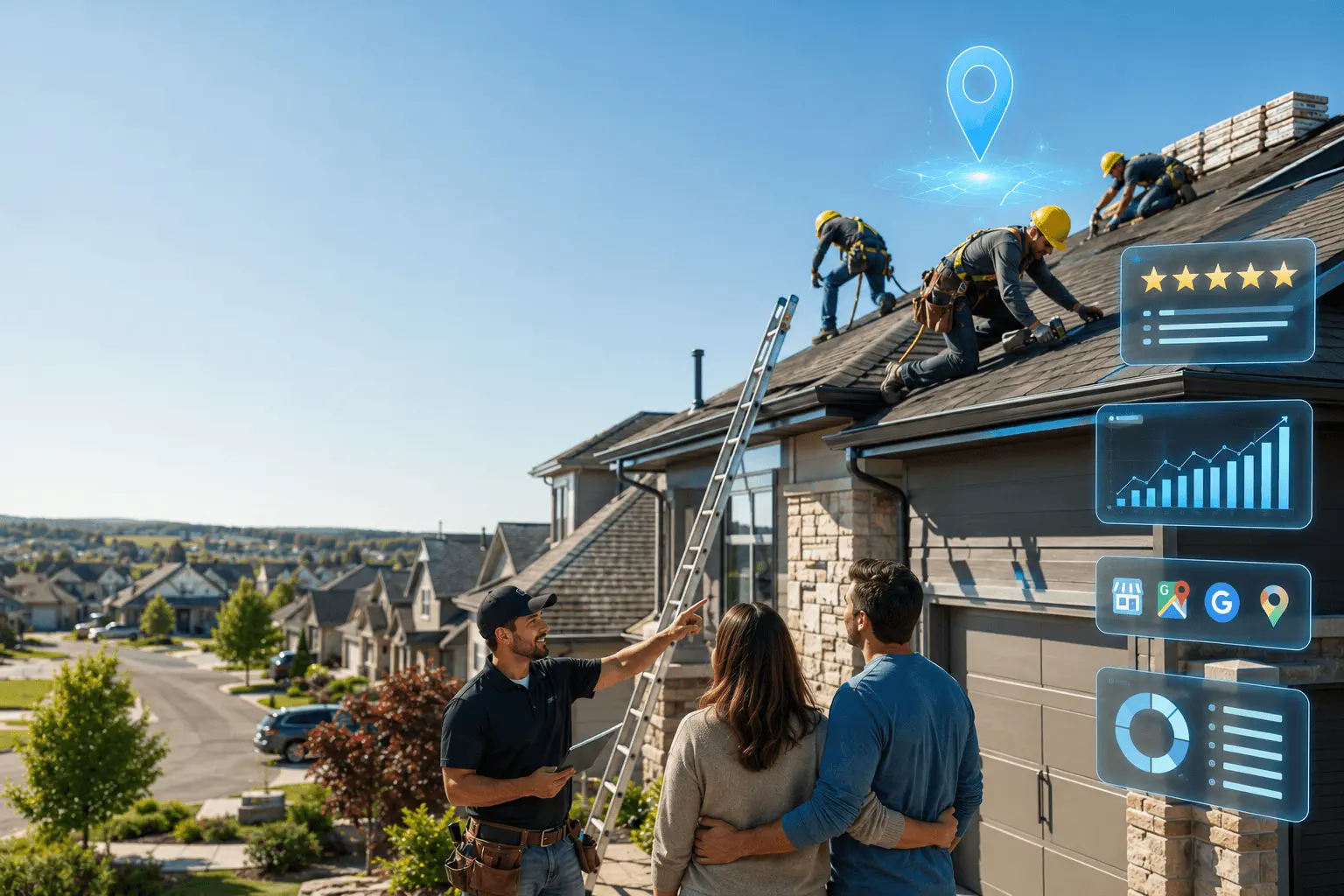
The week after a major hailstorm rolled through a mid-sized city a couple of years back, one roofing company I worked with got 46 calls in four days. A competitor three miles away, with a nearly identical crew size and a similar reputation on the ground, got 6. Same storm, same damage, same general area. The difference wasn't luck or word of mouth. It was that one company showed up in the local pack the moment panicked homeowners started searching "roof repair near me," and the other didn't show up at all until page two.
Roofing is one of the most search-driven, high-stakes local industries there is. Most customers only need a roofer once every decade or two, they're often dealing with real urgency after storm damage, and they're comparing options fast, usually based on whoever looks most credible in the first few seconds of a Google search. Here's exactly how to make sure that's you.
Why Roofing Local SEO Has Its Own Rules
Roofing sits at an unusual intersection: high-ticket transactions, low purchase frequency, seasonal and storm-driven demand spikes, and a genuinely high level of customer distrust built up from years of storm-chasing contractors and insurance scams in the industry. That combination means roofing companies need to work harder than most local trades to establish credibility quickly, while also being ready to capture sudden, urgent surges in demand that can appear with almost no warning.
If you want expert help with this, explore our Local SEO Services — we work with service businesses across the UK, Dubai, and UAE.
Google Business Profile Setup for Roofers
Category selection
Select "Roofing contractor" as your primary category, and add every genuinely relevant secondary category available, such as general contractor if you do broader exterior work, or specific categories for gutter installation if that's part of your service lineup. Avoid selecting categories that don't actually apply just to appear in more searches.
Services section
List every core service separately with a real description: roof replacement, roof repair, storm damage inspection, gutter installation, roof inspection, emergency tarping, and any specialty materials or systems you install. Vague, single-word service listings give both Google and potential customers far less to work with.
Photos that actually build trust
- Before and after photos of completed roofs, ideally from a range of material types and roof styles
- Crew photos on the job, in proper safety gear, since this reassures customers you run a legitimate, professional operation
- Drone or aerial shots of finished work, which have become increasingly common and effective in this industry
- Photos of your branded vehicles and equipment
- Close-up material and craftsmanship shots that highlight quality work customers might not notice from the ground
Reviews Matter More for Roofers Than Almost Any Other Trade
Because most customers hire a roofer once in a very long while, they can't rely on personal experience or a friend's fresh recommendation the way they might for a more frequent service. Reviews become the primary substitute for that missing familiarity, and roofing customers tend to read through more of them than customers shopping for smaller, lower-stakes services.
Ask for a review immediately after the final walkthrough and payment, when the relief of a completed job is freshest. Send a direct text link rather than relying on the customer to remember later. Given the size of a typical roofing transaction, a modest, consistent flow of detailed, specific reviews, mentioning the type of work, the crew, and the outcome, does more to build trust than a large volume of short, generic ones.
Respond to every review, and take particular care with negative ones. Roofing disputes, often tied to insurance claims or material disagreements, are watched closely by prospective customers trying to gauge how a company handles conflict. A calm, specific, professional public response to a negative review can do real work toward reassuring the next homeowner comparing their options.
Storm Response: The Single Biggest Local SEO Opportunity in Roofing
Storm damage searches spike suddenly and dramatically, and being genuinely prepared before a storm hits, not scrambling to catch up after, is one of the highest-leverage things a roofing company can do for local visibility.
- Keep a dedicated, evergreen storm damage page on your website ready year-round, rather than building one reactively after a storm has already happened
- Update your Google Business Profile posts immediately after a local storm event with clear, helpful information, since fresh, timely posts get noticed by both customers and Google's activity signals
- Make sure your phone number and emergency contact information are prominently visible and functioning, since a missed call during a storm surge is a lost customer, often permanently
- Keep your service area settings accurate and current, since storm damage searches are intensely local and time-sensitive
Companies that treat storm readiness as an ongoing part of their SEO and operations, rather than a scramble triggered by the weather report, consistently capture a disproportionate share of the surge in demand that follows severe weather.
Local Citations Worth Prioritizing for Roofers
- General directories: Better Business Bureau, Angi, HomeAdvisor, Yelp
- Roofing-specific directories and manufacturer certification pages, such as certified installer listings for major shingle and roofing material brands
- Local chamber of commerce and regional contractor association listings
- Insurance-adjacent directories where homeowners search for approved or recommended contractors following storm claims
Manufacturer certification listings deserve particular attention in this industry. Being listed as a certified installer for a well-known roofing material brand carries real credibility weight with customers and often includes a direct link back to your business that most competitors in your area aren't taking advantage of.
Hyper-Local Content Ideas Specific to Roofing
- Local building codes and permit requirements for roof replacement in your specific city or county
- The typical roof lifespan and common failure patterns for the housing stock and architectural styles common in your area
- Regional weather patterns, hail frequency, wind exposure, or snow load considerations relevant to your service area
- A neighborhood-by-neighborhood breakdown of common roofing materials and ages, if your city has visibly distinct housing eras across different areas
- Insurance claim guidance specific to how your state or region typically handles storm damage claims
This kind of specific, locally grounded content does double duty. It supports search visibility, and it directly addresses the credibility gap roofing companies often have to overcome with wary homeowners doing their research before committing to a major expense.
Handling Multiple Service Areas as a Roofing Company
Many roofing companies serve a fairly wide multi-town or multi-county region rather than a single city. Resist the urge to build a large number of thin, templated location pages. Instead, prioritize the towns that drive the most business, and build genuinely detailed pages for those first, expanding deliberately rather than all at once. A handful of strong, specific location pages consistently outperforms a large stack of shallow ones.
Common Local SEO Mistakes Roofing Companies Make
- Waiting until after a storm hits to build storm damage content, missing the peak search window entirely
- Listing an unrealistically large service area that dilutes relevance for the towns that matter most
- Neglecting review requests during the busiest, most exhausting stretches of storm season, which is exactly when the strongest reviews are available
- Underusing before and after photos, despite roofing being one of the most visually convincing trades to showcase
- Ignoring manufacturer certification listings that come with built-in credibility and often a free backlink
- Failing to respond to negative reviews tied to insurance disputes, which are exactly the reviews prospective customers scrutinize most closely
Website Structure and Lead Capture for Roofing Companies
Beyond the Google Business Profile itself, a roofing company's website needs to be built for a visitor who is often stressed, comparing several options quickly, and looking for reassurance as much as information. A homepage that leads with clear service categories, prominent licensing and insurance information, and an easy way to request a free estimate or emergency inspection tends to convert far better than a generic layout borrowed from a template.
- Put your phone number in a fixed position visible on every page, especially on mobile, where most storm damage searches happen
- Include a simple, short contact form as a backup for customers who prefer not to call immediately
- Feature your service area clearly near the top of the homepage so visitors instantly confirm you cover their location
- Display licensing, insurance, and manufacturer certification badges prominently rather than burying them on a separate page
- Keep your free estimate or inspection request process to as few steps as possible
A slow, cluttered, or confusing website undoes a lot of the trust that a strong review profile and solid photos work to build. For an industry where the average project value is high and the decision is infrequent, every unnecessary friction point on the website is a real cost, not a minor inconvenience.
Frequently Asked Questions
Fairly important, particularly for storm damage traffic, since a slow-loading site during a high-urgency search moment can cost a call that would otherwise have converted. Prioritize a fast, mobile-friendly site given how often storm damage searches happen on a phone.
Generally no, unless the two sides of the business operate as genuinely separate entities with different branding and locations. A single, well-organized profile with clear service descriptions for both residential and commercial work is usually more effective than splitting visibility across two competing listings.
Yes. Content around spring roof inspections, fall maintenance before winter, and seasonal material considerations keeps a profile active and relevant year-round rather than only during storm-driven demand spikes.
This varies by market, but roofing companies competing seriously in a local pack in a mid-sized city typically need review counts well into the double or triple digits, given how heavily customers lean on reviews for this kind of high-stakes purchase.
Yes. Featuring certifications prominently on your homepage and service pages reinforces the same credibility signal for human visitors that the directory listings provide for search visibility.
Final Thoughts
Roofing customers make an infrequent, high-stakes decision under conditions that are often stressful and time-sensitive, and local SEO for this industry has to account for that reality directly: fast credibility building through reviews and photos, genuine readiness before storms hit rather than after, and content that speaks to the specific concerns a wary homeowner actually has. That company from the start of this post that took 46 calls instead of 6 hadn't done anything exotic. They'd simply kept their storm content ready, their reviews flowing, and their profile accurate, every single month, so that when the storm actually came, they were already positioned to catch the wave instead of chasing it.
If a major storm hit your area tomorrow, is your profile actually ready to catch that surge?
Want Results Like This for Your Business?
Get a free Local SEO audit — we will show you exactly what is holding your rankings back and the fastest path to the Google map pack.
Talk to a Local SEO Specialist →