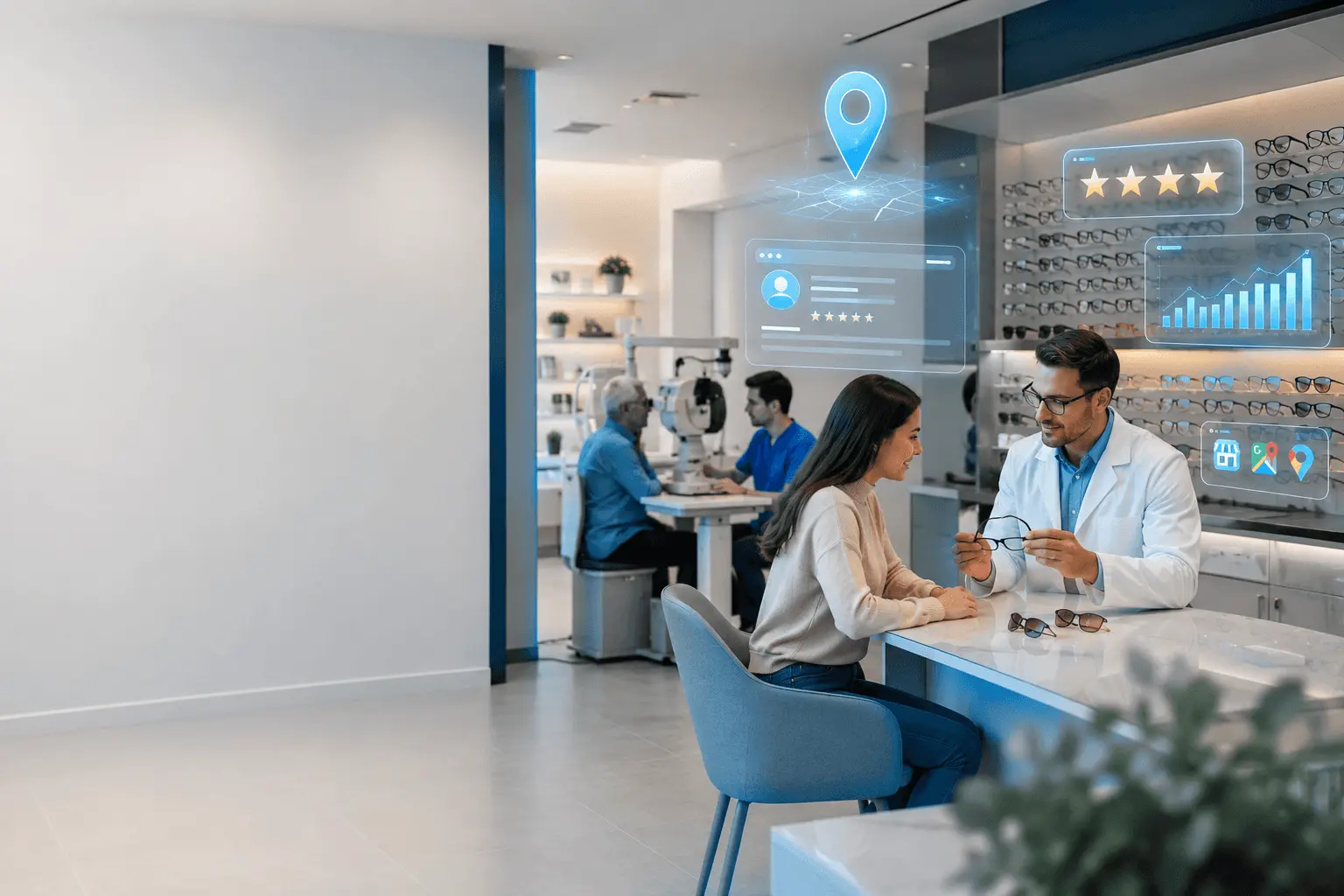
Someone breaks their glasses on a Tuesday morning. Someone else notices their eyes have been blurry for weeks and finally decides to do something about it. Both of them do the same thing next: they pull out a phone and search for an optician near them. If your practice does not show up in that moment, it does not matter how skilled your opticians are or how good your frame selection is. You simply are not in the running.
That is the entire case for local SEO. Nearly half of all Google searches carry local intent, and for a business like an optical practice, where patients want someone close by who can see them soon, that share is likely even higher. This guide walks through what actually moves the needle for opticians specifically, not generic small business advice repackaged with "eyewear" swapped in.
Why Local SEO Matters More for Opticians Than for Most Businesses
Optical practices sit in an unusual spot. You are part healthcare provider and part retailer, which means patients search for you in two very different ways. Some look for "eye exam near me" or "optometrist accepting my insurance." Others search "glasses shop near me" or "same day glasses repair." A local SEO strategy that only accounts for one side of that business misses half the opportunity.
If you want expert help with this, explore our Local SEO Services — we work with service businesses across the UK, Dubai, and UAE.
Google's local pack, the map and three business block that appears above regular search results, captures the overwhelming majority of clicks for these kinds of searches. Most mobile users who run a local search visit a business within a day, and a large share of those visits happen because the business showed up in that top block. If you are not appearing there, you are competing for scraps further down the page.
There is also a trust dimension unique to healthcare adjacent businesses. People are more cautious about who touches their eyes than who sells them a t-shirt. Reviews, complete business information, and professional presentation carry more weight here than in most local search categories, because patients are making a judgment about competence, not just convenience.
Claim and Properly Build Out Your Google Business Profile
Everything starts here. Google Business Profile is free, and it is the single highest leverage asset most opticians never fully use.
Choosing the right categories
Category selection deserves real thought. Set your primary category as Optometrist if you have a doctor on staff performing exams, or Optician if your practice focuses on dispensing and fitting eyewear without exams. From there, add secondary categories that genuinely apply, such as Eyewear Store, Contact Lenses Supplier, Eye Care Center, or Sunglasses Store. Do not stack irrelevant categories just to appear in more searches. Google has gotten better at penalizing profiles that look like they are gaming the system, and a mismatched category can hurt more than it helps.
Keeping your information consistent
Keep your name, address, and phone number identical everywhere your business appears online: your website, your Google profile, Yelp, Facebook, insurance directories, and anywhere else you are listed. Inconsistent formatting, like "St." in one place and "Street" in another, or a missing suite number, sends a weak trust signal to Google and confuses patients trying to find you.
Photos, posts, and the Q&A section
Fill in every field Google offers: services, products, business description, attributes, opening date, and health and safety details if relevant. Add photos regularly, not just once at setup. Interior shots, your frame displays, your exam equipment, and your team all help, and profiles with strong photo libraries tend to outperform bare bones ones. Post updates when you run a promotion, add a new frame line, or extend hours, since an active profile signals to Google that the business is real and current.
Do not ignore the Q&A section either. Patients ask questions there before ever calling, and if you leave it empty, competitors or random users sometimes fill it with wrong information. Seed it yourself with the questions you actually get asked, like whether you take walk-ins or which insurance plans you accept.
Build a Review Engine That Does Not Feel Like a Sales Pitch
Reviews are one of the strongest ranking and conversion signals in local search, and for an optical practice they matter even more because they double as a proxy for clinical trust. Most consumers read reviews before choosing a local business, and practices with thin review counts or ratings under four stars tend to see fewer conversions even when they rank well.
The practical fix is a simple, repeatable ask. Train front desk staff to ask for a review at checkout, right after the patient has picked up new glasses or finished a good exam experience, when satisfaction is highest. A text message with a direct link removes friction. Avoid review gating tools that filter unhappy patients away from public review sites before they can post, since this violates most review platforms' terms and can get your profile suspended if discovered.
Respond to every review, good and bad. A thoughtful response to a negative review often matters more to future patients than the negative review itself. It shows how the practice handles problems, which is exactly what someone is trying to judge before trusting you with their eye care.
Create Service and Location Pages That Actually Rank
A homepage that says "welcome to our practice" cannot rank for the dozens of specific searches patients run. Build dedicated pages for each core service: comprehensive eye exams, contact lens fittings, designer eyewear, children's vision, and any specialty service like dry eye treatment or myopia management. Each page should explain what the service involves, who it is for, and what to expect, written for a real patient rather than stuffed with keywords.
If you serve more than one town or neighborhood, build a page for each, but only if you can write something genuinely useful and specific to that area. A page that just swaps the city name into an otherwise identical paragraph does more harm than good. Mention nearby landmarks, parking situations, or which neighborhoods you regularly see patients from.
Local organic rankings, the standard blue links below the map block, weight on page content and link authority differently than the map pack does. A practice can rank well in one without ranking in the other, so both service pages and general site authority still matter even after your Google Business Profile is dialed in.
Local Citations and Directories Worth the Time
Citations are mentions of your business name, address, and phone number on other websites. They used to be one of the biggest local ranking levers, and while their weight has declined relative to reviews and Google Business Profile signals, consistency across them still matters.
For opticians specifically, prioritize healthcare relevant directories over generic ones, such as Healthgrades, Zocdoc, and vision specific insurance provider directories. General directories like Yelp, Apple Maps, Bing Places, and Facebook are still worth claiming and keeping accurate, since patients use all of them, not just Google.
Skip paying for large citation building packages that blast your information across hundreds of low quality directories. A handful of accurate, relevant listings outperform a hundred sloppy ones, and cleanup after a bad citation service is more expensive than doing it right the first time.
Content That Actually Brings In Local Search Traffic
Blog content works for opticians when it answers questions real patients are searching, not generic filler about eye health. Think about the questions your front desk answers on the phone every week: how often to replace contact lenses, the difference between an eye exam and a vision screening, whether insurance covers progressive lenses. Each of those is a real search query with real intent behind it, and a clear, honest answer on your site can pull in patients who were not searching for your business by name.
Seasonal content works particularly well in this category. Back to school vision screenings, allergy season and contact lens discomfort, or holiday gift guides for sunglasses all map to real search spikes at predictable times of year.
A Few Tools Worth Knowing About
You do not need an expensive enterprise SEO platform to manage local SEO for a single practice or small group. A single location business can typically run a solid local SEO effort on a modest monthly tool budget, layered on top of the free tools Google already provides.
Google Business Profile, Google Search Console, and Google Analytics cover the essentials for free and should be the foundation regardless of what else you use. For review monitoring and citation tracking, tools like BrightLocal or Whitespark are built specifically for local SEO and are reasonably priced for independent practices. For broader keyword research, Semrush or Ahrefs offer more horsepower than most single location practices need, but can be worth a short term subscription when first building out service pages.
Common Mistakes Opticians Make With Local SEO
A few patterns show up again and again. Practices claim their Google Business Profile once and never touch it again, letting hours, photos, and posts go stale. Multi location groups let listings drift out of sync with slightly different names or phone number formats. Websites bury service information behind vague navigation instead of dedicated pages Google can rank. And plenty of practices chase reviews for a month after reading an article like this one, then stop, when what works is a small, consistent habit maintained for years.
None of this requires a large budget or a technical team. It requires picking the handful of things that matter most for a healthcare adjacent local business, doing them properly, and keeping at them.
Frequently Asked Questions
Most practices see initial movement in Google Business Profile visibility within four to eight weeks of cleaning up categories, photos, and information. Meaningful ranking improvements on competitive terms like "eye doctor near me" typically take three to six months of consistent reviews, content, and citation work.
Use whichever accurately describes the core service. If a doctor on staff performs eye exams, Optometrist is usually the stronger primary category. If the practice focuses on dispensing and fitting eyewear without performing exams, Optician fits better. Add the other as a secondary category if it genuinely applies.
No. List accepted insurance clearly on one page, ideally alongside your services or a dedicated insurance page, and keep it current. A separate page per plan usually creates thin, repetitive content that does not help rankings and can look spammy.
Generally not the large bulk packages. A handful of accurate listings on relevant, high quality directories outperforms hundreds of low quality ones, and many bulk services create more cleanup work than value.
There is no fixed number, but practices with fewer than ten reviews or ratings under four stars tend to convert worse even when visible. Aim for steady growth over time rather than a single push, since consistency matters more than hitting a specific total.
Conclusion
Local SEO for opticians is not complicated, but it is easy to do halfway. A complete, active Google Business Profile, a steady stream of real reviews, service pages built for actual patient questions, and clean information across the directories that matter will outperform almost any expensive one time campaign. The practices that win the local pack over the next few years will not be the ones with the biggest marketing budget. They will be the ones that treated these unglamorous basics as an ongoing part of running the practice, not a project to finish once and forget.
What is the first thing you are going to fix this week: your categories, your photos, or finally asking every patient at checkout for a review?
Want Results Like This for Your Business?
Get a free Local SEO audit — we will show you exactly what is holding your rankings back and the fastest path to the Google map pack.
Talk to a Local SEO Specialist →